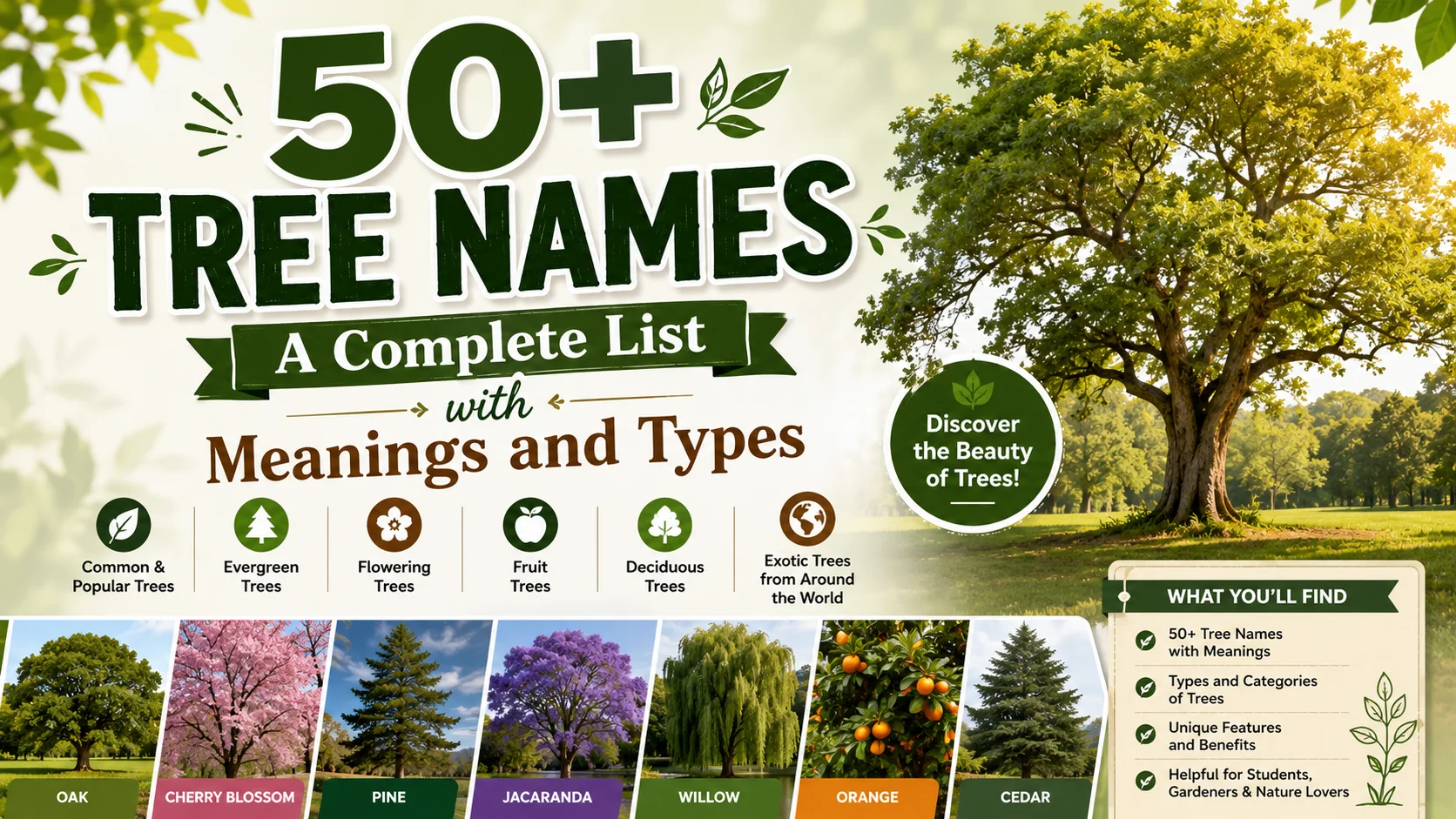
Trees form an essential part of the planet’s ecosystem, providing oxygen, shelter, and resources for countless species. Understanding tree names allows for better appreciation of the natural world and helps in identifying the diverse species that populate forests, cities, and landscapes. This guide offers a thorough look at various categories of trees, from common species to rare and unique varieties.
What Are Tree Names?
Tree names are the common labels used to identify the thousands of woody perennial plants that inhabit the earth. Unlike their scientific binomial nomenclature, which is used universally by botanists, common tree names often vary by region and language. They describe a wide range of plants from towering redwoods to small flowering dogwoods. These names often reflect a tree’s appearance, its uses, or the region where it is found. While scientists classify trees into categories like gymnosperms and angiosperms, everyday tree names provide an accessible way for people to connect with and identify the flora around them. Understanding these names helps communicate about trees, whether for gardening, conservation, or simple appreciation.
Iconic Deciduous Trees
Deciduous trees are the giants that shed their leaves annually, creating spectacular displays of color in the autumn. These tree names are some of the most familiar in temperate regions around the world.
- Oak – Known for its strength and acorns, a symbol of endurance
- Maple – Famous for its vibrant fall colors and sweet sap
- Birch – Recognizable by its distinctive white, peeling bark
- Elm – A tall tree with a broad crown, historically common in cities
- Ash – Valued for its straight grain and use in tool handles
- Beech – A smooth-barked tree producing edible nuts called beechnuts
- Sycamore – A large shade tree with mottled, peeling bark
- Willow – A graceful tree with drooping branches, often found near water
- Poplar – A fast-growing, tall tree used for timber and paper
- Chestnut – Produces edible nuts and strong, durable wood
- Alder – A tree that thrives in moist soils near rivers and streams
- Hickory – Known for its hard wood and edible nuts
- Dogwood – A small tree celebrated for its showy spring flowers
- Aspen – Noted for its leaves that tremble in the slightest breeze
- Hornbeam – A hardwood tree with smooth, grey bark and dense wood
- Basswood – A tree with soft wood and fragrant, bee-attracting flowers
- Sweetgum – Known for its star-shaped leaves and vibrant fall color
- Tulip Tree – A tall tree with distinct, tulip-like flowers
- Hackberry – A tough, adaptable tree with distinctive warty bark
- Mulberry – A fast-growing tree producing sweet, berry-like fruit
Popular Evergreens and Conifers
Evergreen trees retain their foliage throughout the year, providing constant color and structure in the landscape. Conifers are a major group within this category, bearing cones and needle-like leaves.
- Pine – An evergreen with cones and needles, a major source of timber
- Spruce – A tall, conical tree used for paper and as a Christmas tree
- Fir – A conifer with flat needles, often used as a Christmas tree
- Cedar – An aromatic wood, resistant to decay and insects
- Cypress – A slender evergreen, often associated with immortality
- Juniper – An evergreen with berry-like cones, used in flavoring
- Hemlock – A large conifer with flat, fragrant needles
- Redwood – The world’s tallest trees, native to California
- Douglas-fir – A large conifer, a dominant species in Pacific Northwest forests
- Yew – An evergreen with toxic seeds, used in traditional medicine
- Larch – A conifer that is deciduous, shedding its needles in winter
- Arborvitae – Also known as white cedar, used extensively for hedges
- Holly – An evergreen with spiny leaves and bright red berries
- Magnolia – A large tree with impressive, fragrant flowers
- Olive – An evergreen known for its fruit and oil
- Norfolk Island Pine – A tropical conifer popular as a houseplant
- Deodar Cedar – A graceful cedar with drooping branches
- Incense Cedar – A tree with fragrant wood and scale-like leaves
- Giant Sequoia – The largest trees by volume, found in California
- Coast Redwood – The tallest tree species on Earth
Fruit-Bearing Tree Names
Fruit trees are a valuable group cultivated for their edible crops. They provide shade, beauty, and sustenance, making them a common feature in orchards and gardens.
- Mango – A tropical tree producing sweet, juicy fruit
- Apple – A widely grown deciduous tree bearing crisp fruit
- Orange – An evergreen citrus tree known for its vitamin C-rich fruit
- Pear – A fruit-bearing tree yielding sweet, soft fruit
- Peach – A deciduous tree producing fuzzy-skinned, sweet fruit
- Cherry – A tree known for its spring blossoms and small, dark fruit
- Plum – A small tree yielding sweet fruit, eaten fresh or dried
- Lemon – A citrus tree producing sour, yellow fruit used in cooking
- Fig – An ancient tree producing sweet fruit with edible seeds
- Coconut – A tropical palm known for its versatile fruit and water
- Pomegranate – A hardy tree yielding fruit filled with juicy arils
- Avocado – A tree producing a nutrient-rich, creamy fruit
- Banana – A large herbaceous plant often classified as a tree for its size
- Apricot – A small deciduous tree producing a sweet, orange fruit
- Guava – A tropical tree bearing a fruit rich in Vitamin C
- Lychee – A subtropical tree bearing small, sweet, aromatic fruit
- Papaya – A fast-growing tree with large, melon-like fruit
- Persimmon – A tree producing sweet, orange fruit that ripens in autumn
- Nectarine – A smooth-skinned variant of the peach tree
- Breadfruit – A tropical tree that produces large, starchy fruit
Tropical and Subtropical Trees
These tree names come from the warm, humid regions of the world and boast incredible diversity, from towering hardwoods to unique palms.
- Teak – A tropical hardwood valued for its durability in furniture
- Mahogany – A tree known for its reddish-brown, premium timber
- Banyan – A massive tree with aerial roots that form new trunks
- Neem – A tree from India, used for its medicinal properties
- Rubber – A tree that is the primary source of natural rubber
- Palm – A tropical tree with a single trunk and large leaves
- Date Palm – A palm tree cultivated for its sweet, edible fruit
- Bamboo – A fast-growing, woody grass used for construction and crafts
- Jacaranda – A flowering tree known for its vibrant purple blooms
- Acacia – A genus of trees with characteristic thorns and yellow flowers
- Eucalyptus – An Australian tree widely planted for its rapid growth
- Baobab – The “tree of life” in Africa, storing water in its massive trunk
- Cashew – A tree that produces the cashew nut and cashew apple
- Tamarind – A tropical tree with pod-like fruit used in cooking
- Mangrove – A tree that grows in coastal saltwater environments
- Kapok – A tree whose seed pods produce a cotton-like fiber
- Balsa – A fast-growing tree with extremely lightweight wood
- Sago Palm – A cycad that produces a starchy pith used for food
- Rosewood – A tropical hardwood with a distinctive, rich fragrance
- Lignum Vitae – The hardest commercially available wood
Ornamental and Shade Trees
These tree names are often chosen for their aesthetic appeal, providing beauty, shade, and structure in urban and suburban landscapes.
- Japanese Maple – Celebrated for its delicate, colorful leaves
- Crepe Myrtle – A tree with showy, long-lasting summer flowers
- Tulip Tree – A tall tree with distinct, tulip-like flowers
- Ginkgo – A unique, ancient tree with fan-shaped leaves
- Flowering Cherry – A tree prized for its spectacular spring blossoms
- Honey Locust – A popular shade tree with fern-like leaves
- Sweetgum – Known for its star-shaped leaves and vibrant fall color
- London Plane – A large, urban-tolerant tree with mottled bark
- Redbud – A small tree covered in pink flowers in early spring
- Catalpa – A tree with large, heart-shaped leaves and showy flowers
- Linden – A shade tree with fragrant, bee-attracting flowers
- Zelkova – A vase-shaped tree similar to an elm, but more resistant to disease
- Crabapple – A small tree known for its fragrant spring flowers and tiny fruit
- Smoke Tree – A tree with billowy, smoke-like flower clusters
- Sassafras – Known for its distinctive, mitten-shaped leaves and fragrance
- Golden Rain Tree – A tree with yellow flowers and lantern-like seed pods
- Paperbark Maple – A small tree with cinnamon-colored, peeling bark
- Kentucky Coffee Tree – A large tree with compound leaves and large seed pods
- Silk Tree – A tree with fern-like leaves and pink, fluffy flowers
- Crape Myrtle – Known for its long blooming period and smooth, exfoliating bark
Rare and Unique Species
Some tree names are less common, representing species that are endangered, geographically isolated, or possess remarkable characteristics.
- Bristlecone Pine – One of the oldest living organisms on Earth
- Dragon Blood Tree – Notable for its umbrella shape and red sap
- Wollemi Pine – An ancient tree species rediscovered in Australia in 1994
- Monkey Puzzle – A distinctive conifer with sharp, reptilian-looking leaves
- Giant Sequoia – The largest trees by volume, found in California
- Cork Oak – A tree whose bark is harvested to produce cork
- Frankincense Tree – The source of the fragrant resin used since antiquity
- Kauri – A massive, ancient tree species from New Zealand
- African Blackwood – A highly prized wood, used for musical instruments
- Loulu Palm – A group of fan palms endemic to Hawaii, many threatened
- Sandalwood – A tree valued for its fragrant wood and oil
- Ocotillo – A desert plant that grows in a tree-like form
- Palo Verde – A desert tree with green bark that photosynthesizes
- Boojum Tree – A strange, endemic tree from the Baja California peninsula
- Joshua Tree – A distinctive yucca species, emblematic of the Mojave Desert
- Rainbow Eucalyptus – A eucalyptus with strikingly colorful, peeling bark
- Welwitschia – A bizarre tree that produces only two leaves throughout its life
- Quiver Tree – An aloe that grows tree-like in southern Africa
- Angel Oak – A famous, massive live oak in South Carolina
- Methuselah – The name of a specific, ancient bristlecone pine
Medicinal Trees
Throughout history, various parts of trees have been used for their therapeutic properties. The tree names on this list are known for their contributions to traditional and modern medicine.
- Neem – Used for its antiseptic and anti-inflammatory properties
- Willow – The source of salicylic acid, the precursor to aspirin
- Cinchona – The bark contains quinine, used to treat malaria
- Tea Tree – Oil from its leaves is a powerful antiseptic and antifungal
- Eucalyptus – Oil from its leaves helps relieve respiratory issues
- Ginkgo – Extracts from its leaves are used to improve memory and circulation
- Yew – Contains compounds used in chemotherapy drugs
- Birch – The bark and leaves have diuretic and anti-inflammatory uses
- Sassafras – Historically used as a blood purifier and for its oil
- Elder – Flowers and berries have immune-boosting properties
- Pau d’Arco – Bark from this South American tree has antifungal properties
- Slippery Elm – Inner bark used as a demulcent for sore throats
- Witch Hazel – Bark and leaves used as an astringent and skin soother
- Myrrh – Resin with antiseptic and anti-inflammatory properties
- Frankincense – Used for its anti-inflammatory and pain-relieving effects
Desert Trees
These resilient tree names represent species that have adapted to thrive in extreme, arid climates. Their survival strategies are remarkable.
- Joshua Tree – An iconic yucca of the American Southwest
- Palo Verde – A green-barked tree that photosynthesizes through its bark
- Mesquite – A drought-tolerant tree known for its hard wood
- Ironwood – Produces an extremely dense, heavy wood
- Acacia – Many species are adapted to arid and semi-arid environments
- Ocotillo – A spindly plant with bright red flowers
- Boojum Tree – An unusual, columnar tree from Baja California
- Desert Willow – A small tree with showy, trumpet-shaped flowers
- Creosote Bush – A hardy shrub that can grow to tree size
- Agave – Some species grow on large, tree-like stalks
- Cactus – The saguaro is a famous tree-like cactus
- Smoketree – A desert shrub with a distinct smoky appearance
- Catclaw – A desert acacia with curved, sharp thorns
- Cholla – A branching cactus that can grow to tree height
- Pinyon Pine – A small pine that produces edible nuts in arid regions
- Juniper – Many species are well-adapted to dry conditions
- Mountain Mahogany – A drought-tolerant tree from the western US
- Leatherleaf – Known for its tough, leathery leaves
- Soap Tree Yucca – A yucca with tree-like proportions
- Elephant Tree – A small tree with a thickened, twisted trunk
Fast-Growing Trees
For those looking to create shade or privacy quickly, these tree names are excellent choices for rapid growth and establishment.
- Willow – One of the fastest-growing trees, especially near water
- Poplar – Known for its incredibly rapid vertical growth
- Paulownia – Also called the Empress Tree, grows at an astonishing rate
- Eucalyptus – Can grow several meters in a single season
- Sycamore – A vigorous tree that establishes quickly
- Cottonwood – A fast-growing tree that thrives in moist areas
- Birch – Several species are known for fast growth
- Silver Maple – A fast-growing maple with attractive foliage
- Australian Pine – A rapid grower, often used for windbreaks
- Pine – Many species, like the loblolly, grow quickly
- Red Maple – A fast-growing tree with brilliant fall color
- Tulip Tree – Grows quickly and can become quite large
- Mulberry – A fast-growing tree that produces edible fruit
- Royal Empress – A very fast-growing flowering shade tree
- Hybrid Poplar – Bred specifically for rapid growth and biomass
- Alnus – Alders are fast-growing riparian trees
- Leyland Cypress – A popular, fast-growing evergreen for hedges
- Bamboo – The fastest-growing woody plant on earth
- Box Elder – A tough, fast-growing maple relative
- Dawn Redwood – A fast-growing deciduous conifer
Native Trees by Region
Tree names often reflect their origin. Understanding native trees helps in promoting biodiversity and supporting local wildlife.
- Eastern Redbud – Native to eastern North America
- Sugar Maple – Native to northeastern North America, source of maple syrup
- Lobolly Pine – A common pine in the southeastern United States
- Douglas Fir – Native to western North America
- Coast Live Oak – An iconic tree of coastal California
- Quaking Aspen – Native to cooler regions of North America
- Ponderosa Pine – Native to the western United States
- American Beech – A large tree native to eastern North America
- Black Walnut – Native to eastern North America, prized for its wood and nuts
- White Spruce – A common spruce in northern North America
- Paper Birch – Native to northern North America
- Lodgepole Pine – A widespread pine in western North America
- Western Red Cedar – Native to the Pacific Northwest
- Black Cherry – A native tree with edible fruit and valuable wood
- Red Alder – The most common hardwood in the Pacific Northwest
- Madrone – A broadleaf evergreen native to the Pacific coast
- California Bay – A native tree with aromatic leaves
- Jack Pine – A hardy pine native to Canada and the northern US
- Yellow Birch – A large birch native to northeastern North America
- Cottonwood – Several native species across the continent
Wood and Timber Trees
For centuries, certain tree names have been associated with quality timber. These trees are valued for their strength, beauty, and workability.
- Oak – Renowned for its strength and durability, used in flooring and furniture
- Teak – Famous for its resistance to decay and insects, used in shipbuilding
- Mahogany – A premium wood with a beautiful reddish-brown hue
- Walnut – A dense wood known for its rich color and grain
- Cherry – Valued for its warm, reddish tone and fine grain
- Maple – A hard, light-colored wood used for flooring and cabinets
- Ash – Known for its flexibility, used for tool handles and furniture
- Birch – A pale, fine-grained wood used for plywood and veneer
- Pine – A softwood used widely in construction and making paper
- Cedar – An aromatic softwood valued for outdoor use
- Redwood – A durable, lightweight wood from the giant redwood tree
- Spruce – A lightweight wood used for paper, boxes, and musical instruments
- Ebony – A dense black wood prized for decorative items and instruments
- Rosewood – A dense tropical wood with a distinct fragrance and grain
- Hickory – Exceptionally strong, used for tool handles and flooring
- Douglas Fir – A strong, durable wood used for construction
- Hemlock – A softwood used for lumber and pulp
- Poplar – A light, inexpensive wood used for furniture and crates
- Larch – A durable softwood used in construction and posts
- Sycamore – A hard, fine-grained wood used for flooring and furniture
Fragrant and Aromatic Trees
The scent of certain trees can be a defining characteristic. These tree names are associated with some of the most pleasant fragrances in nature.
- Cedar – Its wood has a distinctive, sweet, and woody scent
- Pine – The fresh, clean scent of pine needles is widely recognized
- Sandalwood – Famous for its rich, warm, and lasting fragrance
- Sassafras – The bark and root have a sweet, root-beer-like aroma
- Eucalyptus – Leaves have a potent, refreshing, and medicinal scent
- Juniper – The berries and wood have a sharp, gin-like fragrance
- Frankincense – The resin has a rich, balsamic, and woody aroma
- Myrrh – Resin with a complex, bitter, and medicinal scent
- Olive – The wood and leaves have a subtle, earthy fragrance
- Magnolia – Its flowers produce a heavy, sweet, and citrusy perfume
- Linden – The flowers are intensely fragrant, attracting many bees
- Gardenia – A small tree with heavily scented, waxy white flowers
- Orange – The blossoms have a sweet, uplifting citrus fragrance
- Jasmine – A climbing plant that grows tree-like with sweet, floral scent
- Rosewood – Its wood has a distinct, spicy, and floral perfume
- Spruce – The needles give off a sharp, clean, and piney scent
- Birch – The bark has a sweet, wintergreen-like smell
- Camphor – The wood yields a strong, medicinal, and characteristic odor
- Fir – Needles with a fresh, crisp, and balsamic fragrance
- Mock Orange – A shrub that can grow into a small tree with fragrant flowers
Urban and Street Trees
Urban environments demand tough trees that can withstand pollution, poor soil, and physical damage. The following tree names are often planted along streets and in parks.
- London Plane – Highly tolerant of pollution and compacted soil
- Ginkgo – Extremely hardy, resistant to pests and disease
- Honey Locust – Tolerant of salt, heat, and poor soils
- Elm – Resilient trees, many varieties are drought-tolerant
- Maple – Several species, like the silver maple, are popular in cities
- Linden – A sturdy shade tree that tolerates urban conditions
- Callery Pear – An ornamental tree with a tolerance for city life
- Kentucky Coffee Tree – Adaptable to urban environments
- Zelkova – A tough, disease-resistant alternative to elms
- Oak – Some species, like the live oak, are planted in warm cities
- Sycamore – Fast-growing and tolerant of urban pollution
- Hackberry – An adaptable tree that survives in challenging spots
- Ash – A common street tree until the spread of emerald ash borer
- Tree of Heaven – A fast-growing, but invasive, tree common in cities
- Red Maple – Adapts well to different soil types in urban areas
- Chinese Pistache – A tough tree known for its brilliant fall color
- Crabapple – A small tree suitable for city gardens and medians
- Japanese Pagoda Tree – A hardy, ornamental tree for streets
- Black Locust – Tolerant of poor soils and drought conditions
- Cork Tree – The amur cork tree is a hardy, attractive option for streets
Myths and Legends Surrounding Trees
Trees have been central figures in mythology and folklore for millennia. Exploring the stories behind tree names adds a layer of mystery and reverence to these plants.
In Norse mythology, the mighty ash tree Yggdrasil was the World Tree, a great ash that connected the nine realms . In Greek mythology, the oak was sacred to Zeus, the king of the gods. The olive tree was a gift from Athena, symbolizing peace. The laurel tree, associated with Apollo, was used to crown victors and poets. The banyan tree in Hindu mythology represents immortality and is often the site of significant spiritual events . The baobab’s creation story tells that the god planted it upside down, which is why its branches look like roots. Many cultures have stories about specific trees being the dwelling places of spirits or providing a connection between the earth and the heavens.
Frequently Asked Questions (FAQ)
What are the main categories of trees?
Trees are broadly categorized into two scientific groups: gymnosperms (like conifers) with unprotected seeds, and angiosperms (flowering trees) with seeds enclosed in an ovary. They are also commonly grouped by leaf retention as deciduous, which shed their leaves, or evergreen, which retain their foliage year-round.
What is the difference between a pine and a fir tree?
Pines and firs are both coniferous evergreens, but they differ in their needle arrangement. Pine needles grow in clusters from a single point, while fir needles attach individually to the branch. Additionally, fir cones stand upright on the branches, whereas pine cones hang down.
Which tree is known as the “king of trees”?
The oak tree is often referred to as the “king of trees” in many cultures, symbolizing strength, endurance, and longevity. It has been a significant figure in mythology and history, which contributes to its royal reputation.
What is the oldest tree species in the world?
The bristlecone pine is known to be one of the oldest individual living organisms on Earth. Some specimens in California’s White Mountains are estimated to be over 4,800 years old, making them the oldest known non-clonal trees.
What tree names are best for a beginner to learn?
For anyone starting to learn tree names, focusing on common and distinctive species is recommended. Oak, maple, pine, birch, elm, and willow are excellent starting points. These are widely distributed, have recognizable features, and are frequently mentioned, making them easier to remember and identify.
Why do trees have different common names in different regions?
Common tree names vary by region and language because they are often descriptive, based on local observations, uses, or folklore. This is why a single species might have many different common names. In contrast, the scientific Latin name is universal and avoids this confusion.
What is the difference between a tree and a shrub?
The primary difference lies in size and growth habit. Trees are generally defined as woody perennials that grow to at least 15 to 20 feet tall and have a single main trunk or a distinct crown. Shrubs are smaller, typically under 15 feet, and have multiple stems branching from the ground.

Victoria Blake is a passionate writer and naming enthusiast who enjoys exploring name meanings, origins, and trends. Through Namezpedia, she helps readers discover unique and meaningful names from around the world.