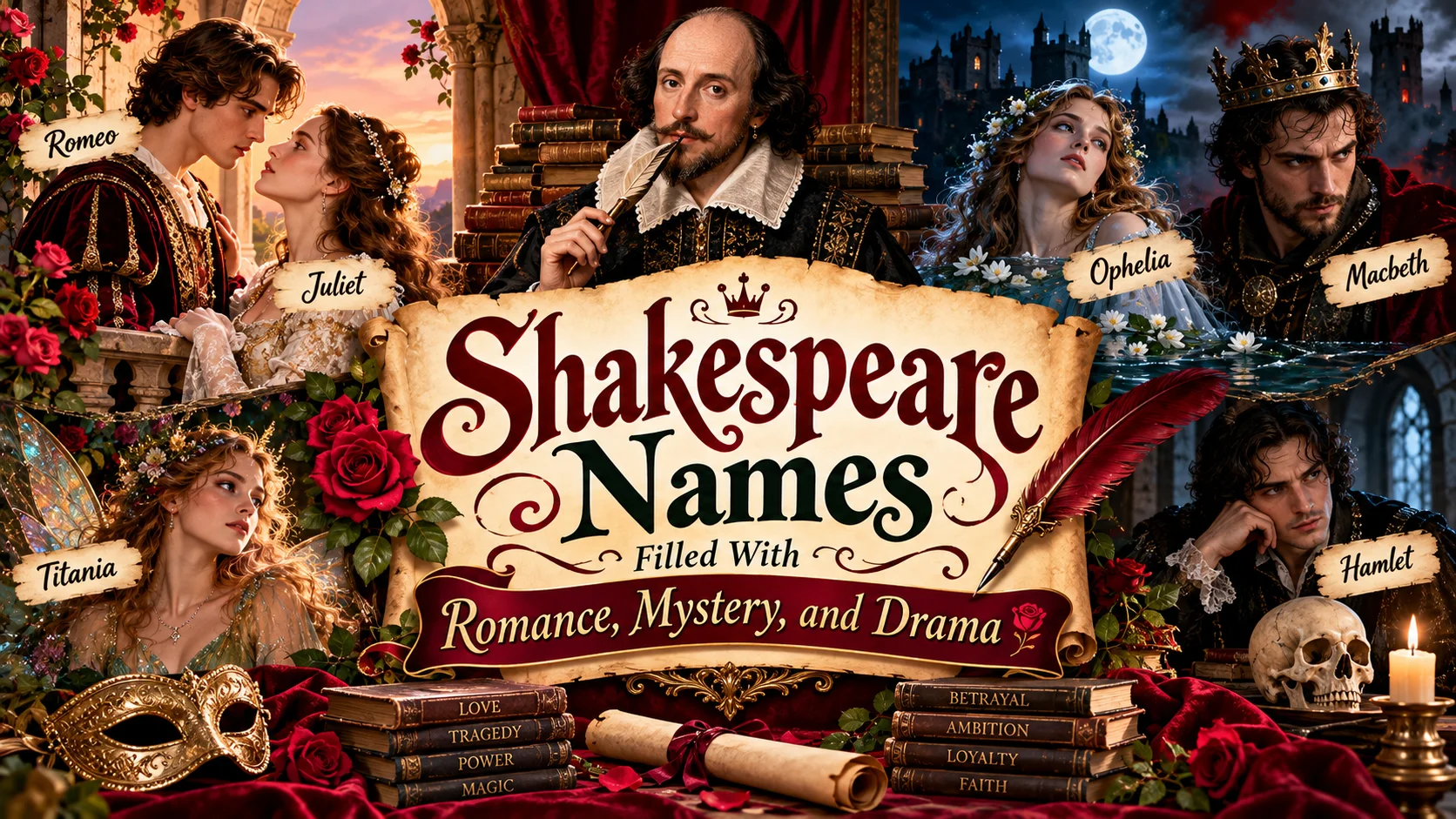
William Shakespeare created some of the most memorable characters in English literature, and their names continue to inspire parents, writers, readers, and lovers of classic stories. From the romantic tragedy of Romeo and Juliet to the magical world of A Midsummer Night’s Dream, Shakespeare’s plays offer a remarkable collection of names filled with beauty, history, ambition, mystery, and emotion.
Whether you’re searching for a meaningful baby name, developing a fictional character, choosing a name for a literary project, or simply exploring Shakespeare’s timeless works, you’ll find plenty of inspiration in his characters. Names such as Juliet, Ophelia, Cordelia, Hamlet, Orlando, and Sebastian carry distinctive associations that make them memorable even centuries after the plays were written.
In this guide, you’ll discover Shakespeare names for kids, romantic names, unusual character names, magical choices, villain-inspired options, and names drawn from famous plays. You’ll also learn about their literary associations and how to choose a name that suits your purpose.
🎭 Why Shakespeare Names Are Still Popular
Shakespeare names remain appealing because they combine literary history with distinctive sounds and memorable characters. Many of his names feel elegant and traditional, while others have an unusual or dramatic quality that makes them stand out in modern storytelling and naming.
Some names, including Juliet, Olivia, Viola, and Sebastian, are still familiar today. Others, such as Titania, Oberon, and Puck, are more closely associated with fantasy and theatrical worlds. Their appeal often comes from the characters themselves: a name may suggest romance, courage, intelligence, ambition, humor, or mystery because of the story in which it appears.
It’s also helpful to distinguish names Shakespeare invented or popularized from names he borrowed from earlier literature, mythology, history, and folklore. Not every character name originated with Shakespeare, but his plays gave many names lasting literary recognition.
🌹 Beautiful Shakespeare Names for Girls
Shakespeare’s plays feature women who are romantic, intelligent, independent, mysterious, and courageous. Their names offer a wide range of styles, from familiar choices to distinctive literary names that feel especially suited to imaginative stories.
- Juliet — The passionate heroine of Romeo and Juliet.
- Ophelia — A tragic character in Hamlet.
- Cordelia — The devoted daughter in King Lear.
- Rosalind — The witty heroine of As You Like It.
- Viola — The resourceful central character in Twelfth Night.
- Olivia — A countess in Twelfth Night.
- Miranda — The compassionate heroine of The Tempest.
- Beatrice — The sharp-witted romantic heroine of Much Ado About Nothing.
- Hero — A young woman in Much Ado About Nothing.
- Portia — An intelligent and resourceful woman in The Merchant of Venice.
- Desdemona — The loving wife in Othello.
- Imogen — A faithful heroine in Cymbeline.
- Perdita — The daughter of Leontes in The Winter’s Tale.
- Helena — A character in A Midsummer Night’s Dream and another in All’s Well That Ends Well.
- Hermia — A young woman in A Midsummer Night’s Dream.
- Titania — The fairy queen in A Midsummer Night’s Dream.
- Celia — Rosalind’s close companion in As You Like It.
- Miranda — A name associated with innocence and wonder in The Tempest.
- Emilia — A significant character in Othello.
- Bianca — A name used for characters in The Taming of the Shrew and Othello.
- Katherine — The central female character in The Taming of the Shrew.
- Anne — A character in The Merry Wives of Windsor.
- Margaret — A name appearing in several Shakespeare plays.
- Maria — Olivia’s attendant in Twelfth Night.
- Jessica — Shylock’s daughter in The Merchant of Venice.
- Tamora — The queen of the Goths in Titus Andronicus.
- Lavinia — A tragic character in Titus Andronicus.
- Cressida — A central figure in Troilus and Cressida.
👑 Strong Shakespeare Names for Boys
Male characters in Shakespeare’s works range from heroic leaders and loyal friends to ambitious rulers and complicated antiheroes. These names are useful for parents seeking literary inspiration, writers building character profiles, or readers who appreciate classic names with a dramatic history.
- Romeo — The romantic hero of Romeo and Juliet.
- Hamlet — The prince at the center of Hamlet.
- Macbeth — The ambitious Scottish nobleman in Macbeth.
- Othello — The central figure of Othello.
- Lear — The king in King Lear.
- Orlando — The romantic hero of As You Like It.
- Sebastian — A key character in Twelfth Night and The Tempest.
- Antonio — A name shared by characters in several plays.
- Benedick — The witty romantic hero of Much Ado About Nothing.
- Claudio — A young nobleman in Much Ado About Nothing.
- Mercutio — Romeo’s witty and energetic friend.
- Tybalt — Juliet’s fiery cousin in Romeo and Juliet.
- Horatio — Hamlet’s loyal friend.
- Laertes — Ophelia’s brother in Hamlet.
- Fortinbras — The Norwegian prince in Hamlet.
- Puck — The mischievous fairy in A Midsummer Night’s Dream.
- Oberon — The fairy king in A Midsummer Night’s Dream.
- Lysander — A young lover in A Midsummer Night’s Dream.
- Demetrius — A young man in A Midsummer Night’s Dream.
- Theseus — The Duke of Athens in A Midsummer Night’s Dream.
- Ferdinand — The prince in The Tempest.
- Prospero — The magician and former Duke of Milan in The Tempest.
- Caliban — An inhabitant of the island in The Tempest.
- Ariel — The spirit who serves Prospero in The Tempest.
- Cassio — Othello’s lieutenant.
- Iago — The manipulative antagonist in Othello.
- Roderigo — A character in Othello.
- Brutus — A Roman senator in Julius Caesar.
- Cassius — A conspirator in Julius Caesar.
- Julius Caesar — The Roman leader at the center of the tragedy.
- Mark Antony — A Roman leader featured in Julius Caesar and Antony and Cleopatra.
- Octavius — The future Augustus Caesar in Shakespeare’s Roman plays.
💕 Romantic Shakespeare Names for Couples and Characters
Romance is one of the most enduring elements of Shakespeare’s work. His love stories include passionate young couples, witty rivals, mistaken identities, unexpected reunions, and relationships tested by family conflict or social expectations.
These names are useful for fictional couples, wedding themes, creative writing, and anyone who wants a literary connection to love and devotion.
- Romeo and Juliet — The iconic lovers whose families are enemies.
- Beatrice and Benedick — A witty couple from Much Ado About Nothing.
- Rosalind and Orlando — Lovers from As You Like It.
- Viola and Orsino — A complicated romantic pairing in Twelfth Night.
- Hero and Claudio — A couple whose relationship faces misunderstanding in Much Ado About Nothing.
- Hermia and Lysander — Young lovers in A Midsummer Night’s Dream.
- Helena and Demetrius — A couple in A Midsummer Night’s Dream.
- Miranda and Ferdinand — Lovers in The Tempest.
- Portia and Bassanio — A married couple in The Merchant of Venice.
- Desdemona and Othello — A tragic married couple in Othello.
- Cleopatra and Antony — Lovers at the center of Antony and Cleopatra.
- Imogen and Posthumus — The married couple in Cymbeline.
- Perdita and Florizel — Young lovers in The Winter’s Tale.
- Silvia and Valentine — A romantic pairing in The Two Gentlemen of Verona.
- Julia and Proteus — A relationship at the center of The Two Gentlemen of Verona.
- Marina and Lysimachus — A romantic pairing in Pericles.
- Bianca and Lucentio — A couple in The Taming of the Shrew.
- Titania and Oberon — The fairy king and queen in A Midsummer Night’s Dream.
- Adriana and Antipholus — A married couple in The Comedy of Errors.
- Anne Page and Fenton — A romantic pairing in The Merry Wives of Windsor.
Not every pairing represents an uncomplicated or ideal relationship. Some are tragic, some involve deception, and others end in reconciliation. That complexity is part of what makes Shakespearean romance so interesting.
🌙 Mysterious and Magical Shakespeare Names
Shakespeare often blended ordinary human drama with magic, prophecy, spirits, fairies, and supernatural events. Plays such as A Midsummer Night’s Dream, Macbeth, and The Tempest are especially rich sources of mysterious names.
These choices are well suited to fantasy novels, role-playing characters, magical stories, or anyone drawn to names with an otherworldly quality.
- Ariel — A magical spirit in The Tempest.
- Puck — A mischievous fairy in A Midsummer Night’s Dream.
- Oberon — The fairy king in A Midsummer Night’s Dream.
- Titania — The fairy queen in A Midsummer Night’s Dream.
- Prospero — A powerful magician in The Tempest.
- Miranda — Prospero’s daughter, whose story involves wonder and discovery.
- Caliban — A complex island inhabitant in The Tempest.
- Sycorax — Caliban’s mother, known through descriptions in The Tempest.
- Hecate — A supernatural figure associated with the witches in Macbeth.
- Weird Sisters — The prophetic witches in Macbeth.
- Banquo — Macbeth’s fellow general, whose story includes a supernatural encounter.
- Fleance — Banquo’s son in Macbeth.
- Ghost — The spirit of Hamlet’s father in Hamlet.
- Puck’s Robin Goodfellow — Another name associated with Puck in A Midsummer Night’s Dream.
- Titania Moon — A modern name combination inspired by the fairy queen.
- Oberon Star — A creative combination inspired by the fairy king.
- Ariel Storm — A modern fantasy-style combination.
- Prospero Vale — A creative combination for a mysterious character.
- Luna Ariel — A modern combination with a magical feel.
- Midnight Puck — A playful fantasy-inspired combination.
Some names in this list refer to supernatural characters, while others are modern combinations inspired by Shakespeare’s imagery. Keeping that distinction clear can help when you are selecting a name for a literary project.
🗡️ Villainous and Dark Shakespeare Names
Shakespeare’s villains are memorable because they are rarely simple. Some manipulate others, some crave power, and some act out of jealousy, insecurity, or revenge. Their names can provide strong inspiration for antagonists in novels, plays, games, and fantasy stories.
- Iago — The manipulative antagonist in Othello.
- Macbeth — A nobleman whose ambition leads to murder and tyranny.
- Lady Macbeth — A powerful character whose ambition and guilt shape the tragedy.
- Richard III — The ambitious king in Richard III.
- Edmund — The scheming son of Gloucester in King Lear.
- Goneril — Lear’s daughter, who turns against him.
- Regan — Lear’s daughter and Goneril’s ally.
- Aaron — A central villain in Titus Andronicus.
- Tamora — Queen of the Goths in Titus Andronicus.
- Don John — The antagonist in Much Ado About Nothing.
- Shylock — The Jewish moneylender in The Merchant of Venice, a complex character shaped by prejudice and revenge.
- Claudius — Hamlet’s uncle and the king of Denmark.
- Rosencrantz — A former acquaintance of Hamlet who becomes involved in the court’s plot.
- Guildenstern — Rosencrantz’s companion in Hamlet.
- Cornwall — A duke in King Lear who participates in the abuse of Gloucester.
- Oswald — Goneril’s steward in King Lear.
- Angelo — The deputy in Measure for Measure, whose actions expose hypocrisy and abuse of power.
- Proteus — A character in The Two Gentlemen of Verona whose betrayal drives the plot.
- Parolles — A boastful soldier in All’s Well That Ends Well.
- Don Pedro — Not a villain, but a powerful prince whose role helps drive the misunderstandings in Much Ado About Nothing.
These names are most effective when their literary associations fit your intended character. For example, Iago is strongly associated with manipulation, while Macbeth represents the destructive consequences of unchecked ambition.
📚 Shakespeare Names Inspired by Famous Plays
If you already have a favorite Shakespeare play, choosing a name from that work can make your selection more meaningful. Each play offers a distinct atmosphere, from romantic comedy to political tragedy and magical adventure.
🌹 Names from Romeo and Juliet
This tragedy is known for its intense romance, family conflict, and heartbreaking ending. Its characters offer names that feel passionate, youthful, and dramatic.
- Romeo
- Juliet
- Mercutio
- Benvolio
- Tybalt
- Rosaline
- Friar Laurence
- Paris
- Nurse
- Escalus
👑 Names from Hamlet
Hamlet explores grief, revenge, loyalty, and uncertainty. Its names are ideal for literary projects and characters with thoughtful, mysterious, or tragic qualities.
- Hamlet
- Ophelia
- Horatio
- Laertes
- Gertrude
- Claudius
- Polonius
- Fortinbras
- Rosencrantz
- Guildenstern
🌿 Names from A Midsummer Night’s Dream
This comedy mixes romance, mistaken identity, and fairy magic. Its names are especially suitable for fantasy stories and imaginative characters.
- Titania
- Oberon
- Puck
- Hermia
- Helena
- Lysander
- Demetrius
- Theseus
- Hippolyta
- Bottom
🌊 Names from The Tempest
The Tempest combines magic, betrayal, forgiveness, and discovery on a remote island. Its characters provide unusual names for fantasy writing and creative naming projects.
- Prospero
- Miranda
- Ariel
- Caliban
- Ferdinand
- Alonso
- Sebastian
- Antonio
- Gonzalo
- Sycorax
🌺 Names from As You Like It
This romantic comedy follows characters who find freedom and new perspectives in the Forest of Arden. Its names suit nature-inspired, playful, and romantic characters.
- Rosalind
- Orlando
- Celia
- Oliver
- Touchstone
- Jaques
- Phoebe
- Silvius
- Audrey
- Duke Senior
🏰 Names from King Lear
King Lear is a tragedy about family loyalty, power, and the consequences of poor judgment. Its names carry strong associations with authority, conflict, and emotional complexity.
- Lear
- Cordelia
- Goneril
- Regan
- Edgar
- Edmund
- Kent
- Gloucester
- Oswald
- Albany
✨ Unusual Shakespeare Names You May Not Know
Beyond Shakespeare’s most famous characters, his plays contain many unusual names that can feel fresh to modern readers. Some are drawn from older sources, while others are memorable because of their unusual sounds or dramatic roles.
- Adriana — From The Comedy of Errors.
- Luciana — Adriana’s sister in The Comedy of Errors.
- Emilia — Appears in Othello.
- Nerissa — Portia’s attendant in The Merchant of Venice.
- Mopsa — A shepherdess in The Winter’s Tale.
- Dorcas — Another shepherdess in The Winter’s Tale.
- Feste — The witty fool in Twelfth Night.
- Malvolio — Olivia’s steward in Twelfth Night.
- Dogberry — The comically inept constable in Much Ado About Nothing.
- Verges — Dogberry’s companion in Much Ado About Nothing.
- Costard — A clown in Love’s Labour’s Lost.
- Armado — A Spanish braggart in Love’s Labour’s Lost.
- Holofernes — A schoolmaster in Love’s Labour’s Lost.
- Moth — A page in Love’s Labour’s Lost.
- Bottom — A weaver and comic character in A Midsummer Night’s Dream.
- Quince — The organizer of the amateur play in A Midsummer Night’s Dream.
- Snout — A tradesman in A Midsummer Night’s Dream.
- Starveling — Another tradesman in the play.
- Pistol — A comic soldier appearing in the history plays.
- Nym — A comic soldier in several plays.
- Bardolph — A companion of Falstaff.
- Falstaff — The witty knight featured in the history plays and The Merry Wives of Windsor.
- Touchstone — The fool in As You Like It.
- Jaques — A reflective lord in As You Like It.
- Autolycus — A charming rogue in The Winter’s Tale.
💎 Shakespeare Names With Interesting Meanings and Associations
A character’s name can have a historical meaning, a linguistic origin, or an association created by the play. These details can help you choose a name based on both its sound and the story attached to it.
| Name | Common meaning or association | Shakespeare connection |
|---|---|---|
| Juliet | A form related to Julia; commonly associated with youth | Romeo and Juliet |
| Cordelia | Often associated with heart or daughter of the sea in popular name references; origins are debated | King Lear |
| Ophelia | Commonly linked to the Greek word for help or benefit | Hamlet |
| Miranda | From Latin mirandus, meaning worthy of admiration | The Tempest |
| Viola | Latin for violet | Twelfth Night |
| Olivia | Commonly associated with the olive tree | Twelfth Night |
| Rosalind | A name with historical roots and several proposed origins | As You Like It |
| Helena | Traditionally associated with brightness or shining light | A Midsummer Night’s Dream |
| Sebastian | Derived from a Greek place-name meaning venerable or revered | Twelfth Night and The Tempest |
| Orlando | Italian form of Roland, a name associated with legendary literature | As You Like It |
| Romeo | Italian form related to a pilgrim or person from Rome, depending on interpretation | Romeo and Juliet |
| Ariel | A Hebrew name commonly interpreted as “lion of God” | The Tempest |
| Titania | A name associated with the Titans in classical mythology | A Midsummer Night’s Dream |
| Oberon | A form associated with the name Auberon and legendary fairy kings | A Midsummer Night’s Dream |
| Beatrice | Derived from a Latin name often associated with blessedness or happiness | Much Ado About Nothing |
Name meanings can vary by linguistic source and historical period. If you plan to use a name because of its precise etymology, consult a reliable name dictionary rather than relying on a simplified interpretation.
🖋️ How to Choose the Perfect Shakespeare Name
Choosing a Shakespeare name is easier when you first decide what the name needs to represent. A name for a baby may need to feel familiar and practical, while a name for a fantasy character can be more unusual, dramatic, or closely tied to a particular play.
Start with the character’s personality. A thoughtful character might suit Hamlet or Horatio, while a witty and confident character could fit Beatrice or Benedick. Consider the traits you want the name to suggest.
Choose a literary atmosphere. Romantic names such as Juliet and Orlando create a different mood from darker choices such as Iago or Macbeth. Match the name to the tone of your story or project.
Consider pronunciation and spelling. Some names are easy to recognize, while others may require explanation. If the name is intended for everyday use, say it aloud and consider whether people are likely to spell it correctly.
Check the character’s story. A name may carry associations that are different from what you expect. Ophelia, for example, is associated with tragedy, while Cordelia is often remembered for her loyalty to her father. Read a short character summary before making your choice.
Think about originality. A famous name can create an immediate literary connection, but a less familiar name may give your character more individuality. You can also use a modern combination inspired by Shakespeare without presenting it as an original character name.
Look beyond the most famous plays. Exploring comedies, histories, and less frequently read tragedies can reveal names that are unusual but still rooted in Shakespeare’s work.
❓ Frequently Asked Questions About Shakespeare Names
Shakespeare’s characters provide names for many purposes, from baby-name inspiration and literary projects to fantasy writing and theatrical productions. These answers address common questions about the origins and uses of Shakespearean names.
What are the most famous Shakespeare names?
Some of the best-known Shakespeare names include Romeo, Juliet, Hamlet, Ophelia, Macbeth, Othello, Portia, Rosalind, Beatrice, and Puck. Their continued recognition comes from the popularity of the plays and the memorable characters associated with them.
What are the prettiest Shakespeare names for girls?
Popular choices include Juliet, Cordelia, Rosalind, Ophelia, Viola, Miranda, Olivia, and Celia. If you prefer a more unusual name, consider Titania, Imogen, Perdita, or Nerissa.
What are strong Shakespeare names for boys?
Strong options include Orlando, Sebastian, Hamlet, Romeo, Benedick, Horatio, Prospero, and Atlas-inspired modern combinations. For a name connected with royalty and history, you might explore Henry, Richard, or Lear.
Which Shakespeare names are romantic?
Juliet and Romeo are the most iconic romantic names, but Rosalind, Orlando, Beatrice, Benedick, Miranda, Ferdinand, Portia, and Bassanio also have important romantic associations in their respective plays.
Which Shakespeare names are magical or mysterious?
Ariel, Puck, Oberon, Titania, Prospero, Hecate, and Caliban are associated with supernatural or mysterious elements. These names work especially well for fantasy characters and imaginative stories.
Did Shakespeare invent all the names in his plays?
No. Shakespeare borrowed many names from historical records, mythology, folklore, and earlier literary works. His contribution often came from adapting these sources and giving the characters memorable roles in his plays.
Are Shakespeare names suitable for baby names?
Many Shakespeare names are suitable for modern baby names, including Juliet, Olivia, Viola, Sebastian, Orlando, and Emilia. Consider pronunciation, personal associations, and whether you are comfortable with the character’s story before choosing one.
What is the most famous couple in Shakespeare?
Romeo and Juliet are arguably Shakespeare’s most famous romantic couple. Their story of love and family conflict has become one of the best-known tragedies in world literature.
🌹 Conclusion
Shakespeare’s plays offer an extraordinary collection of names filled with romance, mystery, humor, ambition, and drama. From Juliet and Ophelia to Romeo and Sebastian, these names connect modern readers with characters and stories that have remained meaningful for generations.
Whether you’re searching for a baby name, developing a fictional character, planning a literary project, or simply exploring classic literature, take time to consider both the sound of the name and its story. A name like Rosalind may suggest wit and independence, while Ariel brings a magical association and Horatio evokes loyalty.
Explore the characters, choose the qualities that matter most to you, and let Shakespeare’s imaginative world inspire a name with its own lasting character.

Victoria Blake is a passionate writer and naming enthusiast who enjoys exploring name meanings, origins, and trends. Through Namezpedia, she helps readers discover unique and meaningful names from around the world.