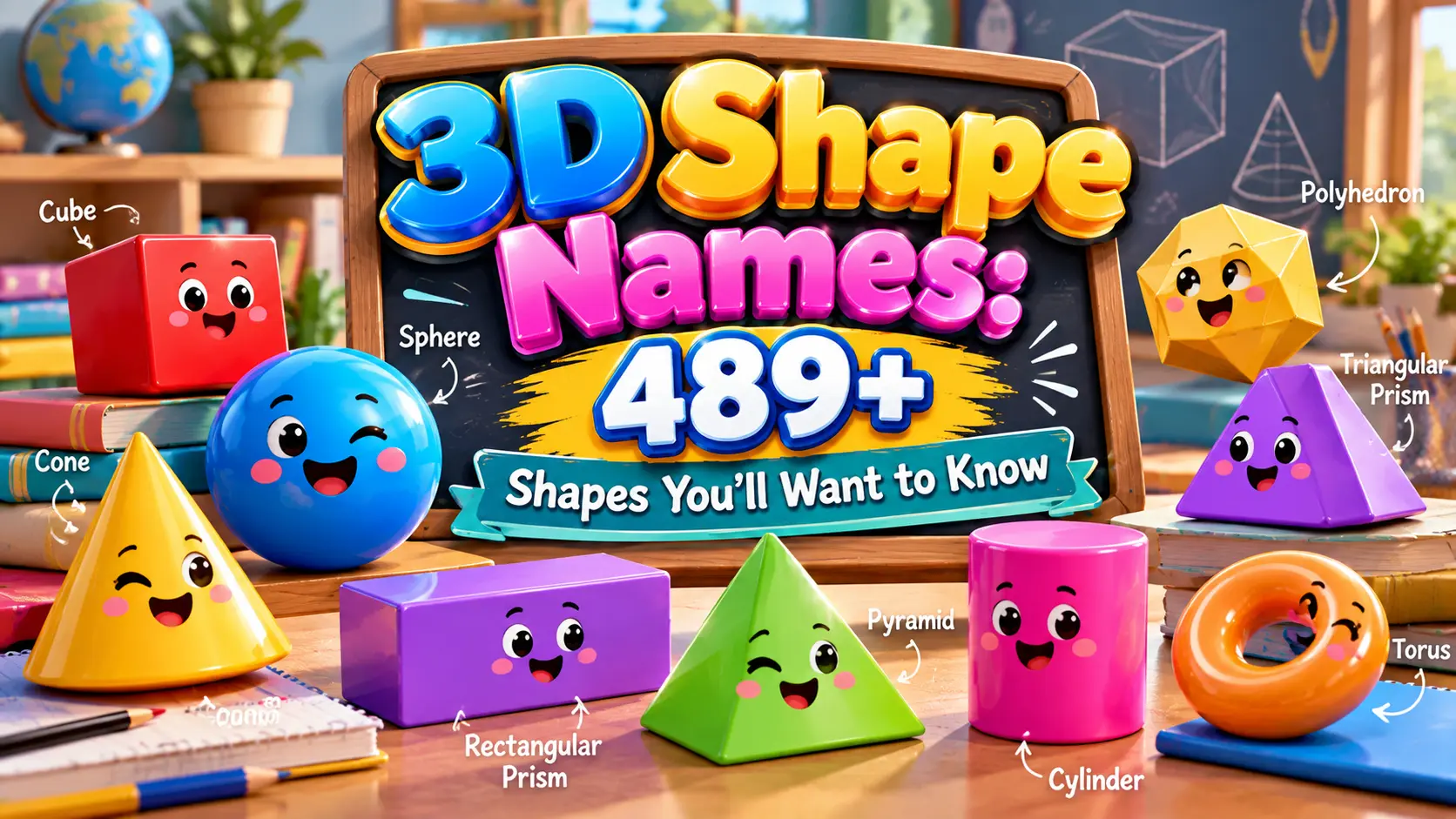
Three-dimensional shapes are everywhere around us. From a simple cube or sphere to unusual polyhedra and curved solids, 3D shape names help us describe objects that have length, width, and height. Learning these names makes geometry easier to understand because each shape has its own structure, faces, edges, vertices, surfaces, and properties.
Some 3D shapes are familiar from everyday life. A dice resembles a cube, a can resembles a cylinder, a soccer ball resembles a sphere, and an ice-cream cone resembles a cone. Others, such as dodecahedrons, icosahedrons, prisms, pyramids, and truncated solids, appear more often in mathematics, architecture, engineering, design, and science.
This guide explores 489+ 3D shape names, organized into practical categories. You’ll find common solid shapes, geometric solids, polyhedra, prisms, pyramids, Platonic solids, curved shapes, unusual 3D forms, and examples from everyday objects.
🔷 Common 3D Shape Names
These are some of the most familiar three-dimensional shapes. They are commonly introduced in elementary geometry because their structures are easy to visualize and connect with everyday objects.
- Cube
- Cuboid
- Rectangular prism
- Square prism
- Triangular prism
- Pentagonal prism
- Hexagonal prism
- Octagonal prism
- Cylinder
- Cone
- Sphere
- Hemisphere
- Pyramid
- Triangular pyramid
- Square pyramid
- Pentagonal pyramid
- Hexagonal pyramid
- Octagonal pyramid
- Tetrahedron
- Octahedron
- Dodecahedron
- Icosahedron
- Torus
- Ellipsoid
- Prism
- Frustum
📦 Basic Solid Shapes for Kids
Young learners usually begin with a small group of recognizable solids. These names are useful when teaching children how to identify objects according to their three-dimensional properties.
- Cube
- Cuboid
- Sphere
- Cylinder
- Cone
- Pyramid
- Triangular prism
- Rectangular prism
- Square pyramid
- Hemisphere
- Oval solid
- Half-cylinder
- Half-sphere
- Cone frustum
- Pyramid frustum
- Pentagonal prism
- Hexagonal prism
- Octagonal prism
- Triangular pyramid
- Hexagonal pyramid
- Ball
- Tube
- Block
- Wedge
- Capsule
📐 3D Geometric Shapes
Geometric solids are mathematical objects defined by their surfaces and spatial structure. They form an important part of three-dimensional geometry and are used to study volume, surface area, symmetry, and spatial relationships.
- Cube
- Cuboid
- Sphere
- Cylinder
- Cone
- Prism
- Pyramid
- Tetrahedron
- Octahedron
- Dodecahedron
- Icosahedron
- Frustum
- Torus
- Ellipsoid
- Paraboloid
- Hyperboloid
- Hemisphere
- Spherical cap
- Spherical sector
- Spherical segment
- Wedge
- Prismatoid
- Antiprism
- Bipyramid
- Trapezohedron
🧊 Cube-Like 3D Shapes
Cube-like solids have flat faces and straight edges. The cube is the best-known example, while rectangular prisms and other box-shaped solids appear throughout mathematics and everyday objects.
- Cube
- Cuboid
- Rectangular prism
- Square prism
- Rectangular box
- Brick
- Hyperrectangle
- Tesseract projection
- Truncated cube
- Rectified cube
- Cantellated cube
- Rhombic hexahedron
- Parallelepiped
- Rhombohedron
- Oblique prism
- Right prism
- Square cuboid
- Golden cuboid
- Elongated cube
- Beveled cube
🔺 3D Pyramid Names
A pyramid has a polygonal base and triangular faces that meet at a common apex. The name usually depends on the shape of its base.
- Pyramid
- Triangular pyramid
- Square pyramid
- Pentagonal pyramid
- Hexagonal pyramid
- Heptagonal pyramid
- Octagonal pyramid
- Nonagonal pyramid
- Decagonal pyramid
- Dodecagonal pyramid
- Regular pyramid
- Irregular pyramid
- Right pyramid
- Oblique pyramid
- Elongated pyramid
- Gyroelongated pyramid
- Truncated pyramid
- Frustum
- Square frustum
- Triangular frustum
- Pentagonal frustum
- Hexagonal frustum
- Octagonal frustum
- Star pyramid
- Concave pyramid
🔺 Triangular 3D Shapes
Triangles can form several different three-dimensional solids. These shapes are important in geometry because triangular faces frequently appear in polyhedra.
- Triangular prism
- Triangular pyramid
- Tetrahedron
- Trigonal prism
- Trigonal antiprism
- Trigonal bipyramid
- Trigonal trapezohedron
- Elongated triangular pyramid
- Gyroelongated triangular pyramid
- Truncated triangular prism
- Truncated tetrahedron
- Rectified tetrahedron
- Triangular frustum
- Triangular wedge
- Triangular bipyramid
- Triangular cupola
- Triangular rotunda
- Snub tetrahedron
- Disphenoid
- Triangular prismatoid
🟨 Square-Based 3D Shapes
Square bases create many familiar solids, including the cube, square pyramid, and square prism. These shapes are useful when learning about faces, edges, vertices, and volume.
- Cube
- Square prism
- Square pyramid
- Square bipyramid
- Square antiprism
- Square cupola
- Square rotunda
- Truncated square pyramid
- Elongated square pyramid
- Gyroelongated square pyramid
- Rectangular prism
- Square cuboid
- Square frustum
- Square prismatoid
- Rhombic hexahedron
- Square trapezohedron
- Tetragonal prism
- Tetragonal antiprism
- Tetragonal pyramid
- Tetragonal bipyramid
- Tetragonal trapezohedron
- Tetragonal disphenoid
- Elongated square bipyramid
- Square wedge
- Square-based frustum
🔷 Pentagonal 3D Shapes
Pentagonal solids have five-sided bases or pentagonal faces. They are less common in everyday objects but appear frequently in mathematical models and polyhedral geometry.
- Pentagonal prism
- Pentagonal pyramid
- Pentagonal antiprism
- Pentagonal bipyramid
- Pentagonal trapezohedron
- Pentagonal cupola
- Pentagonal rotunda
- Elongated pentagonal pyramid
- Gyroelongated pentagonal pyramid
- Truncated pentagonal prism
- Pentagonal frustum
- Pentagonal prismatoid
- Pentagonal dipyramid
- Pentagonal wedge
- Pentagonal toroid
- Regular pentagonal prism
- Right pentagonal prism
- Oblique pentagonal prism
- Pentagonal pyramid frustum
- Pentagonal bipyramid frustum
🔷 Hexagonal 3D Shapes
Hexagonal solids are particularly useful in architecture, chemistry, crystals, packaging, and mathematics. A hexagonal prism is one of the easiest examples to recognize.
- Hexagonal prism
- Hexagonal pyramid
- Hexagonal antiprism
- Hexagonal bipyramid
- Hexagonal trapezohedron
- Hexagonal cupola
- Hexagonal rotunda
- Elongated hexagonal pyramid
- Gyroelongated hexagonal pyramid
- Truncated hexagonal prism
- Hexagonal frustum
- Hexagonal prismatoid
- Hexagonal dipyramid
- Hexagonal wedge
- Hexagonal toroid
- Regular hexagonal prism
- Right hexagonal prism
- Oblique hexagonal prism
- Hexagonal pyramid frustum
- Hexagonal bipyramid frustum
🛑 Octagonal 3D Shapes
Octagonal solids have eight-sided bases or faces. Their geometry can be found in decorative structures, architectural designs, containers, and mathematical models.
- Octagonal prism
- Octagonal pyramid
- Octagonal antiprism
- Octagonal bipyramid
- Octagonal trapezohedron
- Octagonal cupola
- Octagonal rotunda
- Elongated octagonal pyramid
- Gyroelongated octagonal pyramid
- Truncated octagonal prism
- Octagonal frustum
- Octagonal prismatoid
- Octagonal dipyramid
- Octagonal wedge
- Regular octagonal prism
- Right octagonal prism
- Oblique octagonal prism
- Octagonal pyramid frustum
- Octagonal bipyramid frustum
- Octagonal solid
🧱 Prism Names
A prism has two parallel, congruent polygonal bases connected by rectangular or parallelogram-shaped faces. Its name usually comes from the polygon used for the base.
- Triangular prism
- Square prism
- Rectangular prism
- Pentagonal prism
- Hexagonal prism
- Heptagonal prism
- Octagonal prism
- Nonagonal prism
- Decagonal prism
- Hendecagonal prism
- Dodecagonal prism
- Tridecagonal prism
- Tetradecagonal prism
- Pentadecagonal prism
- Hexadecagonal prism
- Heptadecagonal prism
- Octadecagonal prism
- Enneadecagonal prism
- Icosagonal prism
- Regular prism
- Irregular prism
- Right prism
- Oblique prism
- Uniform prism
- Star prism
🔺 Triangular Prism Names
Triangular prisms are among the most common prism types. They have two triangular bases and three rectangular or parallelogram-shaped lateral faces.
- Triangular prism
- Right triangular prism
- Oblique triangular prism
- Regular triangular prism
- Equilateral triangular prism
- Isosceles triangular prism
- Scalene triangular prism
- Truncated triangular prism
- Uniform triangular prism
- Triangular prismatoid
- Triangular wedge
- Right wedge
- Oblique wedge
- Triangular box
- Triangular solid
- Triangular column
- Elongated triangular prism
- Gyroelongated triangular prism
- Triangular antiprism
- Triangular prism frustum
🟣 Curved 3D Shapes
Not every three-dimensional object has flat polygonal faces. Curved solids have rounded surfaces and are especially common in everyday objects.
- Sphere
- Cylinder
- Cone
- Hemisphere
- Torus
- Ellipsoid
- Paraboloid
- Hyperboloid
- Spheroid
- Oblate spheroid
- Prolate spheroid
- Elliptic cylinder
- Circular cylinder
- Circular cone
- Elliptic cone
- Spherical cap
- Spherical segment
- Spherical sector
- Spherical wedge
- Toroidal shape
- Ring torus
- Horn torus
- Spindle torus
- Lemon
- Capsule
⚪ Sphere-Based 3D Shapes
The sphere is a perfectly rounded solid in which every point on the surface is the same distance from the center. Several related shapes are created by cutting or transforming spheres.
- Sphere
- Hemisphere
- Spherical cap
- Spherical segment
- Spherical sector
- Spherical wedge
- Spheroid
- Oblate spheroid
- Prolate spheroid
- Ellipsoid
- Geoid
- Spherical shell
- Hollow sphere
- Sphere segment
- Sphere sector
- Spherical cone
- Spherical lune
- Spherical triangle
- Spherical tetrahedron
- Spherical polyhedron
🥫 Cylinder Shapes
Cylinders have two parallel circular bases connected by a curved surface. They are common in cans, pipes, bottles, columns, and containers.
- Cylinder
- Circular cylinder
- Right circular cylinder
- Oblique cylinder
- Elliptic cylinder
- Hollow cylinder
- Cylindrical shell
- Half-cylinder
- Quarter-cylinder
- Cylindrical sector
- Truncated cylinder
- Cylinder frustum
- Conical cylinder
- Generalized cylinder
- Parabolic cylinder
- Hyperbolic cylinder
- Elliptical cylinder
- Annular cylinder
- Cylindrical wedge
- Cylindrical segment
🍦 Cone Names
A cone has a circular or polygonal base that narrows toward an apex. Cones are familiar in everyday objects such as ice-cream cones, funnels, and traffic cones.
- Cone
- Circular cone
- Right circular cone
- Oblique cone
- Elliptic cone
- Parabolic cone
- Double cone
- Bicone
- Truncated cone
- Cone frustum
- Conical frustum
- Half-cone
- Cone sector
- Cone segment
- Circular cone
- Elliptical cone
- Right cone
- Oblique cone
- Polyhedral cone
- Generalized cone
🍩 Torus and Ring Shapes
A torus is a ring-shaped solid created by rotating a circle around an external axis in the same plane. It has several variations based on the position and dimensions of the generating circle.
- Torus
- Ring torus
- Horn torus
- Spindle torus
- Self-intersecting torus
- Solid torus
- Toroidal shell
- Toroidal segment
- Toroidal ring
- Double torus
- Triple torus
- Pinched torus
- Twisted torus
- Elliptic torus
- Circular torus
🧊 Platonic Solid Names
The five Platonic solids are among the most famous regular polyhedra. Each has congruent regular polygonal faces and the same number of faces meeting at every vertex.
- Tetrahedron
- Cube
- Octahedron
- Dodecahedron
- Icosahedron
- Regular tetrahedron
- Regular hexahedron
- Regular octahedron
- Regular dodecahedron
- Regular icosahedron
🔷 Archimedean Solid Names
Archimedean solids are highly symmetrical convex polyhedra made from two or more types of regular polygons. They are important examples of uniform geometric solids.
- Truncated tetrahedron
- Cuboctahedron
- Truncated cube
- Truncated octahedron
- Rhombicuboctahedron
- Truncated cuboctahedron
- Snub cube
- Icosidodecahedron
- Truncated dodecahedron
- Truncated icosahedron
- Rhombicosidodecahedron
- Truncated icosidodecahedron
- Snub dodecahedron
🔶 Catalan Solid Names
Catalan solids are duals of the Archimedean solids. Their faces are congruent but generally not regular polygons.
- Triakis tetrahedron
- Rhombic dodecahedron
- Triakis octahedron
- Tetrakis hexahedron
- Rhombic triacontahedron
- Deltoidal icositetrahedron
- Disdyakis dodecahedron
- Pentagonal icositetrahedron
- Icositetrahedron
- Hexakis octahedron
- Rhombic enneacontahedron
- Disdyakis triacontahedron
- Pentagonal hexecontahedron
- Hexakisoicosahedron
- Triakis icosahedron
- Pentakis dodecahedron
- Rhombic triacontahedron
- Deltoidal hexecontahedron
- Disdyakis dodecahedron
- Pentagonal hexecontahedron
⭐ Star-Shaped 3D Solids
Star polyhedra extend geometric forms into more complex structures with pointed or stellated surfaces. They are particularly interesting in advanced geometry and mathematical art.
- Stellated tetrahedron
- Stellated octahedron
- Great stellated dodecahedron
- Small stellated dodecahedron
- Great dodecahedron
- Great icosahedron
- Pentagrammic prism
- Star prism
- Star pyramid
- Star antiprism
- Star bipyramid
- Stellated cube
- Stellated dodecahedron
- Stellated icosahedron
- Pentagrammic antiprism
- Pentagrammic dipyramid
- Stellated prism
- Great rhombicosidodecahedron
- Small stellated prism
- Great stellated prism
🧩 Polyhedron Names
A polyhedron is a three-dimensional solid made from flat polygonal faces. Polyhedra range from simple tetrahedrons to highly complex mathematical forms.
- Tetrahedron
- Hexahedron
- Octahedron
- Dodecahedron
- Icosahedron
- Triangular prism
- Pentagonal prism
- Hexagonal prism
- Square pyramid
- Pentagonal pyramid
- Bipyramid
- Antiprism
- Trapezohedron
- Dipyramid
- Frustum
- Prismatoid
- Johnson solid
- Archimedean solid
- Catalan solid
- Platonic solid
- Uniform polyhedron
- Convex polyhedron
- Concave polyhedron
- Regular polyhedron
- Irregular polyhedron
🔺 Bipyramid Names
A bipyramid can be formed by joining two pyramids along their congruent bases. These solids have two apexes on opposite sides of the central polygon.
- Triangular bipyramid
- Square bipyramid
- Pentagonal bipyramid
- Hexagonal bipyramid
- Heptagonal bipyramid
- Octagonal bipyramid
- Nonagonal bipyramid
- Decagonal bipyramid
- Dodecagonal bipyramid
- Regular bipyramid
- Elongated bipyramid
- Gyroelongated bipyramid
- Truncated bipyramid
- Rhombic bipyramid
- Deltoidal bipyramid
- Dipyramid
- Trigonal bipyramid
- Tetragonal bipyramid
- Pentagonal dipyramid
- Hexagonal dipyramid
🔶 Antiprism Names
Antiprisms have two parallel polygonal faces that are rotated relative to one another and connected by triangular faces. They create attractive symmetrical forms.
- Triangular antiprism
- Square antiprism
- Pentagonal antiprism
- Hexagonal antiprism
- Heptagonal antiprism
- Octagonal antiprism
- Nonagonal antiprism
- Decagonal antiprism
- Dodecagonal antiprism
- Regular antiprism
- Right antiprism
- Oblique antiprism
- Truncated antiprism
- Star antiprism
- Pentagrammic antiprism
- Hexagrammic antiprism
- Elongated antiprism
- Gyroelongated antiprism
- Uniform antiprism
- Twisted antiprism
🌀 3D Shapes With Curved and Flat Surfaces
Some solids combine flat faces with curved surfaces. These hybrid forms appear frequently in manufacturing, architecture, packaging, and product design.
- Capsule
- Cylinder
- Cone
- Frustum
- Hemisphere
- Spherical cap
- Spherical segment
- Cylindrical wedge
- Conical frustum
- Cone-cylinder
- Rounded cube
- Rounded cuboid
- Chamfered cube
- Beveled cylinder
- Filleted box
- Capsule cylinder
- Domed cylinder
- Domed prism
- Rounded prism
- Rounded pyramid
- Half-cylinder
- Half-cone
- Quarter-cylinder
- Quarter-sphere
- Truncated sphere
🏠 Everyday Objects That Look Like 3D Shapes
Geometry becomes easier when you connect mathematical solids with objects you already know. Many common household items closely resemble basic three-dimensional forms.
- Dice — cube
- Shoebox — cuboid
- Book — rectangular prism
- Can — cylinder
- Basketball — sphere
- Globe — sphere
- Ice-cream cone — cone
- Party hat — cone
- Pyramid model — pyramid
- Toblerone-style package — triangular prism
- Brick — cuboid
- Tissue box — rectangular prism
- Soda can — cylinder
- Marble — sphere
- Egg — ellipsoid
- Donut — torus
- Pipe — cylinder
- Funnel — cone
- Traffic cone — cone
- Tent — triangular prism
- Roof — prism
- Pencil — cylinder
- Eraser — cuboid
- Soap bar — cuboid
- Orange — sphere
🎨 3D Shapes Used in Art and Design
Designers frequently use geometric solids to build objects, logos, sculptures, environments, and digital models. Simple solids can also be combined to create much more complicated forms.
- Cube
- Sphere
- Cylinder
- Cone
- Torus
- Pyramid
- Prism
- Capsule
- Hemisphere
- Ellipsoid
- Frustum
- Tetrahedron
- Octahedron
- Dodecahedron
- Icosahedron
- Rounded cube
- Beveled cube
- Extruded polygon
- Revolved surface
- Lofted solid
- Swept solid
- Mesh
- Polyhedron
- Solid of revolution
- Parametric surface
🧠 Advanced 3D Shape Names
Advanced geometry includes solids and surfaces that are less familiar than basic cubes, cones, and spheres. These forms are often studied in higher mathematics, computer graphics, engineering, and theoretical geometry.
- Paraboloid
- Hyperboloid
- Ellipsoid
- Elliptic paraboloid
- Hyperbolic paraboloid
- One-sheet hyperboloid
- Two-sheet hyperboloid
- Conoid
- Helicoid
- Catenoid
- Enneper surface
- Klein bottle
- Möbius solid
- Gyroid
- Dupin cyclide
- Torus
- Spheroid
- Superellipsoid
- Superquadric
- Capsule
- Oloid
- Sphericon
- Steinmetz solid
- Prismatoid
- Rotunda
🧱 3D Shapes With Flat Faces
Flat-faced solids are made entirely from polygonal faces. They are especially important in elementary geometry because students can count their faces, edges, and vertices.
- Cube
- Cuboid
- Tetrahedron
- Octahedron
- Dodecahedron
- Icosahedron
- Triangular prism
- Pentagonal prism
- Hexagonal prism
- Octagonal prism
- Square pyramid
- Pentagonal pyramid
- Hexagonal pyramid
- Bipyramid
- Antiprism
- Trapezohedron
- Frustum
- Prismatoid
- Polyhedron
- Dipyramid
- Wedge
- Rhombohedron
- Parallelepiped
- Disphenoid
- Cupola
🔢 3D Shapes With Different Numbers of Faces
Counting faces is one of the easiest ways to compare solid shapes. The number of faces can help identify a polyhedron and understand its structure.
- Tetrahedron — 4 faces
- Triangular prism — 5 faces
- Square pyramid — 5 faces
- Cube — 6 faces
- Cuboid — 6 faces
- Octahedron — 8 faces
- Pentagonal prism — 7 faces
- Pentagonal pyramid — 6 faces
- Hexagonal prism — 8 faces
- Hexagonal pyramid — 7 faces
- Dodecahedron — 12 faces
- Icosahedron — 20 faces
- Heptagonal prism — 9 faces
- Octagonal prism — 10 faces
- Octagonal pyramid — 9 faces
- Decagonal prism — 12 faces
- Decagonal pyramid — 11 faces
- Dodecagonal prism — 14 faces
- Dodecagonal pyramid — 13 faces
- Bipyramid — depends on its base
📊 3D Shapes and Their Properties
Understanding the properties of a solid is more useful than memorizing its name alone. Faces, edges, vertices, curved surfaces, and dimensions help distinguish one shape from another.
- Cube — 6 faces, 12 edges, 8 vertices
- Cuboid — 6 faces, 12 edges, 8 vertices
- Tetrahedron — 4 faces, 6 edges, 4 vertices
- Triangular prism — 5 faces, 9 edges, 6 vertices
- Square pyramid — 5 faces, 8 edges, 5 vertices
- Pentagonal prism — 7 faces, 15 edges, 10 vertices
- Hexagonal prism — 8 faces, 18 edges, 12 vertices
- Octagonal prism — 10 faces, 24 edges, 16 vertices
- Octahedron — 8 faces, 12 edges, 6 vertices
- Dodecahedron — 12 faces, 30 edges, 20 vertices
- Icosahedron — 20 faces, 30 edges, 12 vertices
- Sphere — one continuous curved surface, no edges or vertices
- Cylinder — 2 flat circular faces and 1 curved surface
- Cone — 1 flat circular face and 1 curved surface
- Hemisphere — 1 flat circular face and 1 curved surface
- Torus — one continuous curved surface
- Frustum — two parallel bases connected by side faces
- Antiprism — two parallel polygonal bases with triangular side faces
- Bipyramid — two pyramids joined at their bases
📐 How to Identify 3D Shapes
Identifying a three-dimensional shape becomes easier when you examine its structure systematically. Start by asking whether the object has flat faces, curved surfaces, or a mixture of both. Then count its faces, edges, and vertices if applicable.
For example, a cube has six square faces, twelve edges, and eight vertices. A sphere has a curved surface but no flat face, edge, or vertex. A cylinder has two circular flat faces and one curved surface. A cone has one circular base and one curved surface that meets at an apex.
The shape’s base can also provide an important clue. A prism has two matching parallel bases, while a pyramid has one base and triangular faces that meet at a point. Once you recognize these structural patterns, identifying unfamiliar solids becomes much easier.
❓ Frequently Asked Questions About 3D Shape Names
What are the basic 3D shapes?
The most commonly taught basic 3D shapes are cube, cuboid, sphere, cylinder, cone, and pyramid. Triangular prisms and other prisms are also commonly introduced in elementary geometry.
What are the five Platonic solids?
The five Platonic solids are the tetrahedron, cube, octahedron, dodecahedron, and icosahedron. Each has regular polygonal faces and the same arrangement of faces around every vertex.
What 3D shape has no edges or vertices?
A sphere has no straight edges and no vertices. Its surface is continuously curved.
What 3D shape has one vertex?
A cone has one vertex, or apex, when considering its usual geometric form. It also has one circular base and one curved surface.
What 3D shape has six faces?
A cube and a cuboid both have six faces. A cube has six equal square faces, while a cuboid has rectangular faces.
What is a polyhedron?
A polyhedron is a three-dimensional solid bounded entirely by flat polygonal faces. Cubes, pyramids, prisms, tetrahedrons, and dodecahedrons are examples.
What is the difference between a prism and a pyramid?
A prism has two congruent, parallel bases connected by lateral faces. A pyramid has one base, while its triangular side faces meet at a single apex.
Is a cylinder a prism?
In elementary geometry, a cylinder is generally treated as a separate type of solid because it has curved lateral surface rather than flat polygonal side faces. A cylinder can be viewed as a generalized prism with a circular base in some mathematical contexts.
What is a 3D shape with a circular base and a point?
A cone has a circular base and a single apex. An ice-cream cone and traffic cone are familiar real-world examples.
What is a dodecahedron?
A dodecahedron is a polyhedron with twelve faces. A regular dodecahedron has twelve regular pentagonal faces, thirty edges, and twenty vertices.
What is an icosahedron?
An icosahedron is a polyhedron with twenty faces. A regular icosahedron consists of twenty equilateral triangular faces, thirty edges, and twelve vertices.
What is a torus?
A torus is a ring-shaped three-dimensional solid or surface. A donut is the familiar everyday object that most closely resembles a torus.
What is a 3D shape called?
A three-dimensional geometric object can be called a solid, solid shape, geometric solid, or 3D shape. Specific objects receive names such as cube, sphere, cone, cylinder, prism, and pyramid.
🎯 Final Thoughts on 3D Shape Names
Learning 3D shape names is about much more than memorizing a vocabulary list. Once you understand the structure of a cube, sphere, cylinder, cone, prism, or pyramid, you can start recognizing geometry in buildings, toys, packaging, artwork, machines, architecture, and nature.
For beginners, start with the familiar solids: cube, cuboid, sphere, cylinder, cone, prism, and pyramid. Then explore more specialized forms such as the Platonic solids, Archimedean solids, Catalan solids, antiprisms, bipyramids, and unusual curved surfaces.
The fascinating part of three-dimensional geometry is that simple shapes can be combined, transformed, truncated, stretched, rotated, or repeated to create incredibly complex structures. Whether you’re studying geometry, teaching children, designing a 3D model, or simply curious about mathematical shapes, knowing their names gives you a useful foundation for exploring the world of spatial geometry.

Victoria Blake is a passionate writer and naming enthusiast who enjoys exploring name meanings, origins, and trends. Through Namezpedia, she helps readers discover unique and meaningful names from around the world.