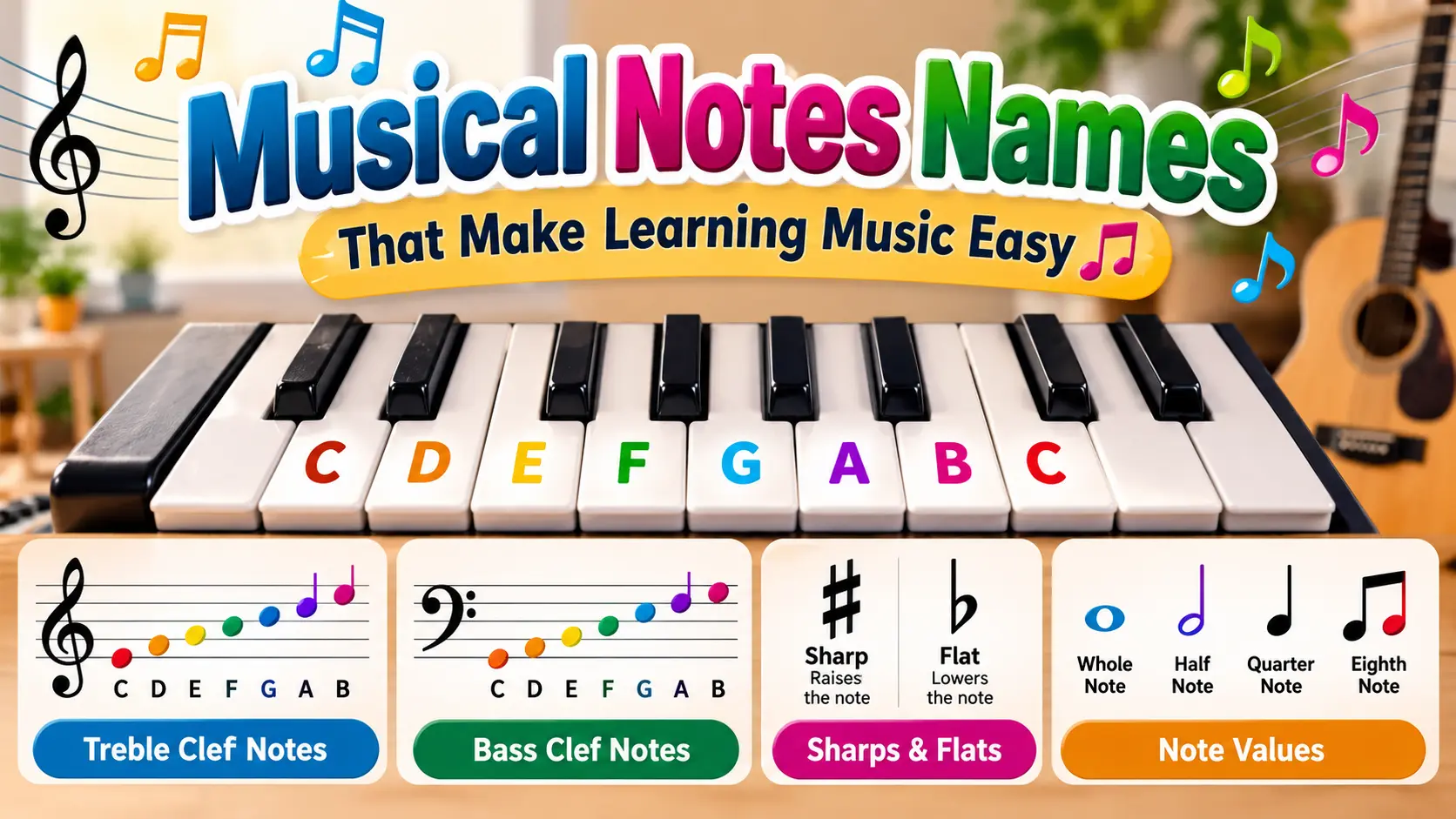
Learning music becomes much easier when you understand musical notes and how they work together. Whether you are learning piano, guitar, violin, singing, or another instrument, musical notes are the foundation of everything you play. They help musicians recognize pitches, read sheet music, build melodies, and communicate musical ideas.
The good news is that you do not need to learn hundreds of different note names to get started. Western music uses seven basic letter names: A, B, C, D, E, F, and G. These notes repeat in different octaves, creating the familiar patterns found in songs, scales, and chords.
In this guide, you will discover the names of musical notes, their order, the difference between sharps and flats, and how notes appear on a music staff. You will also learn how note names work on piano and guitar, how to recognize note values, and which practice techniques can help beginners remember them more easily.
🎵 What Are Musical Notes?
Musical notes represent sounds with identifiable pitches. A pitch describes how high or low a sound seems, allowing musicians to distinguish one note from another.
For example, a high piano sound and a low piano sound may share the same letter name but belong to different octaves. Musical notation helps musicians identify these pitches and understand when and how to play them.
Musical notes can be represented in several ways:
- Letter names: A, B, C, D, E, F, and G.
- Written symbols: Notes placed on lines and spaces of a musical staff.
- Piano keys: White and black keys that produce different pitches.
- Instrument positions: Particular strings, frets, or finger positions on instruments such as guitars and violins.
- Vocal pitches: Sounds singers produce when performing melodies.
A musical note can also have a duration. For instance, a quarter note usually lasts one beat in common time, while a half note usually lasts two beats.
It is important to understand that a note’s name and its duration describe different things. The letter tells you which pitch to play, while the note symbol indicates how long to hold it in the musical context.
🎹 What Are the Seven Basic Musical Note Names?
The seven basic musical note names are A, B, C, D, E, F, and G. These letters form the foundation of the commonly used Western musical naming system.
After G, the sequence begins again at A. This repeating pattern makes learning note names easier because you only need to memorize seven basic letters before exploring sharps, flats, and octaves.
The basic musical notes are:
- A: One of the seven natural note names.
- B: The note immediately before C in the ascending natural-note sequence.
- C: A common starting point for beginner piano lessons.
- D: The note following C.
- E: The note following D.
- F: The note following E.
- G: The final letter in the basic sequence before it repeats.
The ascending order is:
A – B – C – D – E – F – G – A
The descending order is:
A – G – F – E – D – C – B – A
You can also begin the sequence at C, which is particularly useful when learning piano:
C – D – E – F – G – A – B – C
These are natural note names. Sharps and flats create additional note spellings, which you will learn about later in this guide.
🎼 Musical Notes Names in Ascending and Descending Order
Understanding the order of musical notes helps you recognize patterns when playing instruments or reading sheet music. Although the alphabet contains many letters, the basic musical alphabet uses only seven.
Ascending notes move toward higher pitches, while descending notes move toward lower pitches. On a piano, ascending notes generally move from left to right, and descending notes move from right to left.
Here is a simple reference table.
| Direction | Musical note sequence |
|---|---|
| Ascending from C | C, D, E, F, G, A, B, C |
| Descending from C | C, B, A, G, F, E, D, C |
| Ascending from A | A, B, C, D, E, F, G, A |
| Descending from A | A, G, F, E, D, C, B, A |
| Ascending from G | G, A, B, C, D, E, F, G |
| Descending from G | G, F, E, D, C, B, A, G |
Notice that the sequence always returns to its starting letter after moving through seven note names.
The actual sound becomes higher or lower as you move between notes, although the distance between neighboring natural notes is not always the same. For example, E to F is a semitone, while C to D is a whole tone in standard Western tuning.
This distinction becomes useful when learning scales, melodies, and chords.
🎹 Musical Notes Names on a Piano Keyboard
A piano keyboard is one of the easiest places to understand musical note names because the notes appear in a repeating visual pattern.
The keyboard contains white keys and black keys. The white keys represent natural notes, while the black keys usually represent sharps or flats.
Look for a group of two black keys. The white key immediately to their left is C. Once you find C, the next white keys moving right are D, E, F, G, A, and B. The pattern then repeats at the next C.
How to Find the Notes on Piano
- C: Immediately to the left of a group of two black keys.
- D: Between the two black keys in that group.
- E: Immediately to the right of the second black key.
- F: Immediately to the left of a group of three black keys.
- G: Between the first and second black keys in the group of three.
- A: Between the second and third black keys.
- B: Immediately to the right of the third black key.
Once you recognize the groups of two and three black keys, you can identify every natural note on the keyboard.
What About the Black Keys?
Black keys represent notes that are usually named with sharps or flats. For example, the black key between C and D can be called C-sharp or D-flat.
This means the keyboard contains more than seven distinct pitches in each octave. The seven natural note names provide the starting point, while accidentals help identify the pitches between them.
Practicing with a piano diagram or a real keyboard can make this pattern easier to remember.
🎶 What Are Sharps, Flats, and Natural Notes?
Sharps and flats are symbols that change the pitch of a note. They are essential for understanding musical notation, playing songs in different keys, and identifying the black keys on a piano.
A sharp (♯) raises a note by one semitone. A flat (♭) lowers a note by one semitone. A natural sign (♮) cancels a previous sharp or flat in the relevant musical context.
Here are some common examples:
| Note symbol | Name | Meaning |
|---|---|---|
| C | C natural | The natural form of C |
| C♯ | C-sharp | One semitone above C |
| D♭ | D-flat | One semitone below D |
| F♯ | F-sharp | One semitone above F |
| B♭ | B-flat | One semitone below B |
| E♮ | E natural | E without a sharp or flat alteration |
Understanding Enharmonic Notes
Some notes can have different names but produce the same pitch on a standard piano. These are called enharmonic equivalents.
For example:
- C-sharp and D-flat
- D-sharp and E-flat
- F-sharp and G-flat
- G-sharp and A-flat
- A-sharp and B-flat
There are also theoretical exceptions to the common black-key pattern. E-sharp, for example, corresponds to the same piano pitch as F in standard equal temperament, even though the note names differ.
The correct spelling depends on the musical key, harmony, and notation. Beginners can start by learning the common sharp and flat pairs before exploring more advanced music theory.
🎼 How Musical Notes Appear on a Staff
A musical staff is a set of five horizontal lines used to write music. Notes can appear directly on the lines or in the spaces between them.
The position of a note indicates its pitch. The clef at the beginning of the staff tells the musician how to interpret those positions.
Each line and space represents a different letter in the musical alphabet. As you move upward through the staff, the note names continue in alphabetical order and repeat after G.
A staff also includes other symbols, such as:
- Clefs, which establish the reference pitches.
- Key signatures, which indicate the sharps or flats used in a passage.
- Time signatures, which describe the organization of beats.
- Bar lines, which divide music into measures.
- Rests, which indicate periods of silence.
Reading sheet music takes practice, but the staff provides a consistent system for communicating musical ideas.
Why Note Position Matters
Two notes may have the same letter name but sound different if they occupy different octaves. Their vertical positions on the staff help musicians identify which version is intended.
Additional ledger lines extend the staff when notes fall above or below its five lines.
For beginners, it is helpful to learn one clef at a time. The treble clef is often introduced first for higher-pitched parts, while the bass clef is commonly used for lower-pitched parts.
🎻 Treble Clef Note Names
The treble clef is widely used for instruments and musical parts that generally occupy higher registers. It appears in piano right-hand music, flute parts, violin music, and many vocal lines.
The five lines of the treble clef, from bottom to top, are:
E – G – B – D – F
A common memory phrase is “Every Good Boy Does Fine.”
The four spaces, from bottom to top, are:
F – A – C – E
The spaces spell the word FACE, making them easy to remember.
Treble Clef Note Reference
| Staff position | Note name |
|---|---|
| Bottom line | E |
| Second line | G |
| Middle line | B |
| Fourth line | D |
| Top line | F |
| Bottom space | F |
| Second space | A |
| Third space | C |
| Fourth space | E |
Middle C sits on a ledger line below the treble staff in standard notation. It is an important reference point for beginner pianists because it helps connect the right-hand and left-hand parts.
To improve your reading skills, practice identifying random notes on the treble staff rather than memorizing the lines in only one direction.
🎵 Bass Clef Note Names
The bass clef is commonly used for lower-pitched instruments and musical parts. In piano music, the left hand often reads notes written in bass clef.
The five bass-clef lines, from bottom to top, are:
G – B – D – F – A
A useful memory phrase is “Good Boys Do Fine Always.”
The four spaces, from bottom to top, are:
A – C – E – G
You can memorize these spaces by practicing the sequence until each position becomes familiar.
Bass Clef Note Reference
| Staff position | Note name |
|---|---|
| Bottom line | G |
| Second line | B |
| Middle line | D |
| Fourth line | F |
| Top line | A |
| Bottom space | A |
| Second space | C |
| Third space | E |
| Fourth space | G |
Middle C appears on a ledger line above the bass staff. When piano music uses both treble and bass clefs, middle C helps connect the two staves.
The bass clef is especially useful when learning piano, cello, bass guitar notation, trombone, and other lower-register parts. Some instruments use different notation conventions, so check the specific method or score you are studying.
⏱️ Musical Note Names and Their Values
Musical notes have different durations. Their values tell performers how long a sound should last relative to the beat and the other notes in a piece.
In common time, where the quarter note receives one beat, the basic note values are commonly taught as follows.
| Note value | Typical duration in 4/4 time |
|---|---|
| Whole note | 4 beats |
| Half note | 2 beats |
| Quarter note | 1 beat |
| Eighth note | 1/2 beat |
| Sixteenth note | 1/4 beat |
These durations are relative to the chosen beat. In other time signatures or rhythmic contexts, the way a note is felt and counted can differ.
A note’s appearance helps identify its value. A whole note is usually drawn as an open oval without a stem. A half note has an open head and a stem, while a quarter note has a filled head and a stem. Eighth and sixteenth notes include flags or beams.
What Are Musical Rests?
Rests indicate silence rather than a played pitch. They have corresponding durations, so musicians know when to pause.
For example, a quarter rest generally lasts one beat in common time, while a half rest lasts two beats. Rests are just as important as notes because they shape rhythm, phrasing, and musical expression.
Try clapping a rhythm that combines quarter notes, eighth notes, and rests. Counting aloud while clapping can help you understand how different durations fit together.
🎸 Musical Notes Names on a Guitar
Guitarists use the same seven basic note names as pianists, but they find those notes through strings and frets rather than rows of keys.
A standard six-string guitar is usually tuned from the lowest-pitched string to the highest-pitched string as follows:
E – A – D – G – B – E
The thickest string is the low E string, and the thinnest string is the high E string.
Standard Guitar String Names
| String | Note name |
|---|---|
| 6th string | E |
| 5th string | A |
| 4th string | D |
| 3rd string | G |
| 2nd string | B |
| 1st string | E |
Each fret generally raises the open-string pitch by one semitone. For example, pressing the first fret of the low E string produces F. The second fret produces F-sharp, and the third fret produces G.
The pattern continues as you move up the fretboard, with note names repeating in higher octaves.
Why Guitarists Should Learn Note Names
Knowing the notes on the fretboard makes it easier to understand chords, scales, melodies, and music theory. It also helps guitarists communicate with other musicians and move musical patterns to different positions.
Start by memorizing the open strings. Next, learn the notes on the sixth and fifth strings before expanding to the other strings.
Short, regular practice sessions are more effective than trying to memorize the entire fretboard in one sitting.
🎹 What Is the Difference Between Notes, Scales, and Chords?
Notes, scales, and chords are connected, but they describe different musical ideas.
A note is an individual pitch. A scale is an organized sequence of pitches, usually arranged from lower to higher or higher to lower. A chord combines multiple notes played together or understood as a harmonic unit.
For example, C is a note. C major is a scale containing C, D, E, F, G, A, and B. A C major triad contains C, E, and G.
Understanding a Major Scale
A major scale follows the interval pattern:
Whole – Whole – Half – Whole – Whole – Whole – Half
In this pattern, a whole step is two semitones, and a half step is one semitone.
The C major scale uses only natural notes:
C – D – E – F – G – A – B – C
It is commonly used in beginner lessons because it can be played on the white keys of a piano without needing black keys.
Understanding a Basic Chord
A C major triad consists of three notes:
- C, the root.
- E, the major third.
- G, the perfect fifth.
Playing these notes together produces a familiar major-chord sound.
Learning how notes combine into scales and chords helps beginners move beyond playing isolated sounds. It also explains why certain notes sound stable together while others create tension or a desire to resolve.
🎶 What Are Octaves in Music?
An octave is the interval between one pitch and another pitch with twice or half its frequency. Notes an octave apart generally share the same letter name but sound higher or lower.
For example, C4 and C5 are both C notes, but C5 is one octave higher than C4. The number after the letter identifies the octave in scientific pitch notation.
Octaves are important because the seven-note sequence repeats throughout the musical range.
On a piano, the distance from one C to the next C contains twelve semitones. These include the seven natural note names and the five common sharp-or-flat pitch positions between them.
Why Octaves Matter
Octaves help musicians understand registers, arrange melodies, and recognize relationships between notes.
A singer might perform a melody in a lower octave than another singer, while both perform the same basic musical line. Likewise, a guitarist can play a melody in several positions across the fretboard.
Octaves also help when tuning instruments and comparing pitches. Although octave notes sound different in height, they often share a strong sense of musical similarity.
For beginners, locating several C notes across a piano keyboard is an easy way to recognize octave patterns.
🔢 Musical Notes and Their Frequencies
Sound is produced by vibrations, and frequency measures how many cycles occur each second. It is measured in hertz, abbreviated Hz.
In standard tuning, the note A4 is commonly set to 440 Hz. Other pitches have frequencies determined by their relationship to this reference and the tuning system being used.
For example, A5 is one octave above A4 and has a frequency of 880 Hz in standard equal temperament. A3 is one octave below A4 and has a frequency of 220 Hz.
Frequency Examples
| Note | Approximate frequency |
|---|---|
| C4, middle C | 261.63 Hz |
| D4 | 293.66 Hz |
| E4 | 329.63 Hz |
| F4 | 349.23 Hz |
| G4 | 392.00 Hz |
| A4 | 440.00 Hz |
| B4 | 493.88 Hz |
| C5 | 523.25 Hz |
These figures describe standard equal-tempered tuning and are rounded to two decimal places where appropriate.
How Frequency Helps Musicians
Frequency is useful for understanding tuning, audio equipment, sound synthesis, and the physics of music. Digital tuners measure pitch and help performers adjust notes to match a reference.
Beginners do not need to memorize every frequency. Learning note names, hearing pitch relationships, and developing reliable playing technique are usually more useful starting points.
🎤 What Is Solfège, and How Does It Relate to Note Names?
Solfège is a system that uses syllables to represent musical pitches or their roles within a scale. The familiar syllables are:
Do – Re – Mi – Fa – Sol – La – Ti – Do
In movable-do solfège, Do represents the tonic, or first degree, of a major scale. In C major, the syllables correspond to C, D, E, F, G, A, B, and C.
Solfège is commonly used in singing lessons, ear training, and music education. It helps learners connect written notes with the sounds they hear and sing.
Why Solfège Can Be Helpful
Solfège encourages musicians to recognize relationships between notes rather than treating every pitch as an unrelated sound.
For example, singing Do–Re–Mi in different keys helps learners recognize the pattern of a major scale even when its starting pitch changes.
Solfège systems vary. Fixed-do approaches associate syllables with particular note names, while movable-do approaches associate them with scale degrees. Your teacher or learning method may use one system more than the other.
You can begin with the C major scale, singing each syllable slowly while playing the corresponding piano key. Over time, this can improve pitch awareness, confidence, and musical memory.
🧠 Easy Ways to Memorize Musical Note Names
Memorizing note names becomes easier when you practice them in small, repeatable steps. Instead of trying to learn every concept at once, focus on one pattern and use it consistently.
Try these beginner-friendly techniques.
- Say the musical alphabet: Repeat A through G, then start again at A.
- Practice ascending and descending: Name notes while moving up and down a keyboard or instrument.
- Use a piano diagram: Identify C by finding the group of two black keys.
- Learn staff positions separately: Practice treble clef before adding bass clef.
- Use flashcards: Write a note on one side and its name on the other.
- Name guitar strings daily: Recite E, A, D, G, B, E from the lowest string to the highest.
- Play short note patterns: Practice C–D–E–F–G and then return to C.
- Use a metronome: Keep a steady beat while identifying or playing notes.
- Listen carefully: Compare two notes and notice whether the second sounds higher or lower.
- Practice for a few minutes daily: Consistency is more useful than occasional, exhausting study sessions.
A Simple Seven-Day Practice Plan
| Day | Practice activity |
|---|---|
| Day 1 | Memorize A, B, C, D, E, F, and G. |
| Day 2 | Practice ascending and descending note sequences. |
| Day 3 | Find natural notes on a piano keyboard. |
| Day 4 | Learn treble-clef lines and spaces. |
| Day 5 | Learn bass-clef lines and spaces. |
| Day 6 | Identify sharps, flats, and common black-key names. |
| Day 7 | Review the notes and play a simple scale. |
Adjust the schedule to your instrument and experience. Repeat any activity that still feels difficult before moving on to more advanced concepts.
🎼 Common Mistakes Beginners Make When Learning Note Names
Beginners often find musical note names confusing at first. Most difficulties become easier to manage once you understand the difference between note letters, pitch changes, and written notation.
Here are several common mistakes to avoid.
- Skipping a letter: Remember that the musical alphabet follows A through G and then repeats.
- Confusing pitch with duration: A note’s name identifies its pitch, while its rhythmic value describes how long it lasts.
- Ignoring the clef: A staff position means different things depending on whether the music uses treble clef or bass clef.
- Treating every black key as a sharp only: Many black keys can also be named as flats.
- Forgetting octave numbers: C4 and C5 share the letter C but refer to different registers.
- Learning only by visual position: Combine visual practice with listening and playing so that note names become meaningful.
- Rushing through practice: Spend time reviewing difficult notes instead of repeatedly studying only the easiest ones.
A useful habit is to say the note name aloud before playing it. This connects the written symbol, the name, and the sound.
With regular practice, recognizing notes becomes faster and more natural.
❓ Frequently Asked Questions About Musical Notes Names
The following answers cover common questions beginners ask when learning music theory. They are designed to clarify the basic concepts without requiring advanced musical knowledge.
🎵 What Are the Seven Musical Notes?
The seven basic musical note names are A, B, C, D, E, F, and G. They repeat in higher and lower octaves, while sharps and flats identify additional pitch spellings.
🎹 Which Musical Note Comes First?
The musical alphabet is often written starting with A, followed by B, C, D, E, F, and G. Beginner piano lessons frequently start with C because it is easy to locate visually on the keyboard.
🎶 What Comes After G in Music?
After G, the basic musical note sequence returns to A. The same pattern repeats across different octaves.
🎼 How Many Notes Are There in Music?
There are seven basic natural note names in the common Western system. With sharps and flats, a standard twelve-tone equal-tempered octave contains twelve distinct pitch classes.
Other musical traditions use different pitch systems and tuning approaches.
🎹 Are C-Sharp and D-Flat the Same Note?
On a standard piano using equal temperament, C-sharp and D-flat produce the same pitch. They have different names because their spelling depends on musical context.
🎸 What Are the Guitar String Note Names?
Standard guitar tuning from the lowest-pitched string to the highest-pitched string is E, A, D, G, B, E.
🎵 What Is the Difference Between a Note and a Chord?
A note is an individual pitch. A chord combines multiple notes to create a harmonic sound.
🎤 How Can I Learn Musical Notes Quickly?
Practice the seven-note sequence, learn note positions on your instrument, use flashcards, and review staff notation for a few minutes each day. Short and consistent practice sessions help build lasting recognition.
🎼 Why Do Musical Notes Repeat?
The seven letter names repeat because music uses recurring pitch relationships across different octaves. An octave contains twelve semitones in standard Western equal temperament, returning to the same letter name at a higher or lower pitch.
🎹 Do All Instruments Use the Same Note Names?
Many commonly used Western instruments share the same note names, but they differ in range, notation, and playing technique. Some instruments are transposing instruments, meaning their written notes sound at different pitches from the notation.
🎯 Conclusion: Start Learning Musical Notes Today
Understanding musical notes names is one of the most useful first steps in learning music. The seven basic letters—A, B, C, D, E, F, and G—provide the foundation for reading notation, recognizing pitches, playing scales, and building chords.
Once you understand the order of the notes, you can begin identifying natural notes on a piano, memorizing guitar strings, reading treble and bass clefs, and recognizing sharps and flats. Learning note values and rests will also help you understand rhythm and perform music more confidently.
You do not need to master every music theory concept immediately. Start with the basics, practice a little every day, and gradually connect note names with the sounds you hear.
Whether your goal is to play your favorite songs, read sheet music, compose melodies, or improve your singing, learning musical notes gives you a foundation you can build on for years to come.

Victoria Blake is a passionate writer and naming enthusiast who enjoys exploring name meanings, origins, and trends. Through Namezpedia, she helps readers discover unique and meaningful names from around the world.