Introduction
Learning music notes names is one of the first steps toward understanding how music is written and played. Whether you’re learning piano, guitar, violin, singing, music theory, or simply trying to understand sheet music, knowing what the notes are called makes everything much easier. The basic note names may look simple, but they open the door to scales, melodies, chords, keys, octaves, and musical notation.
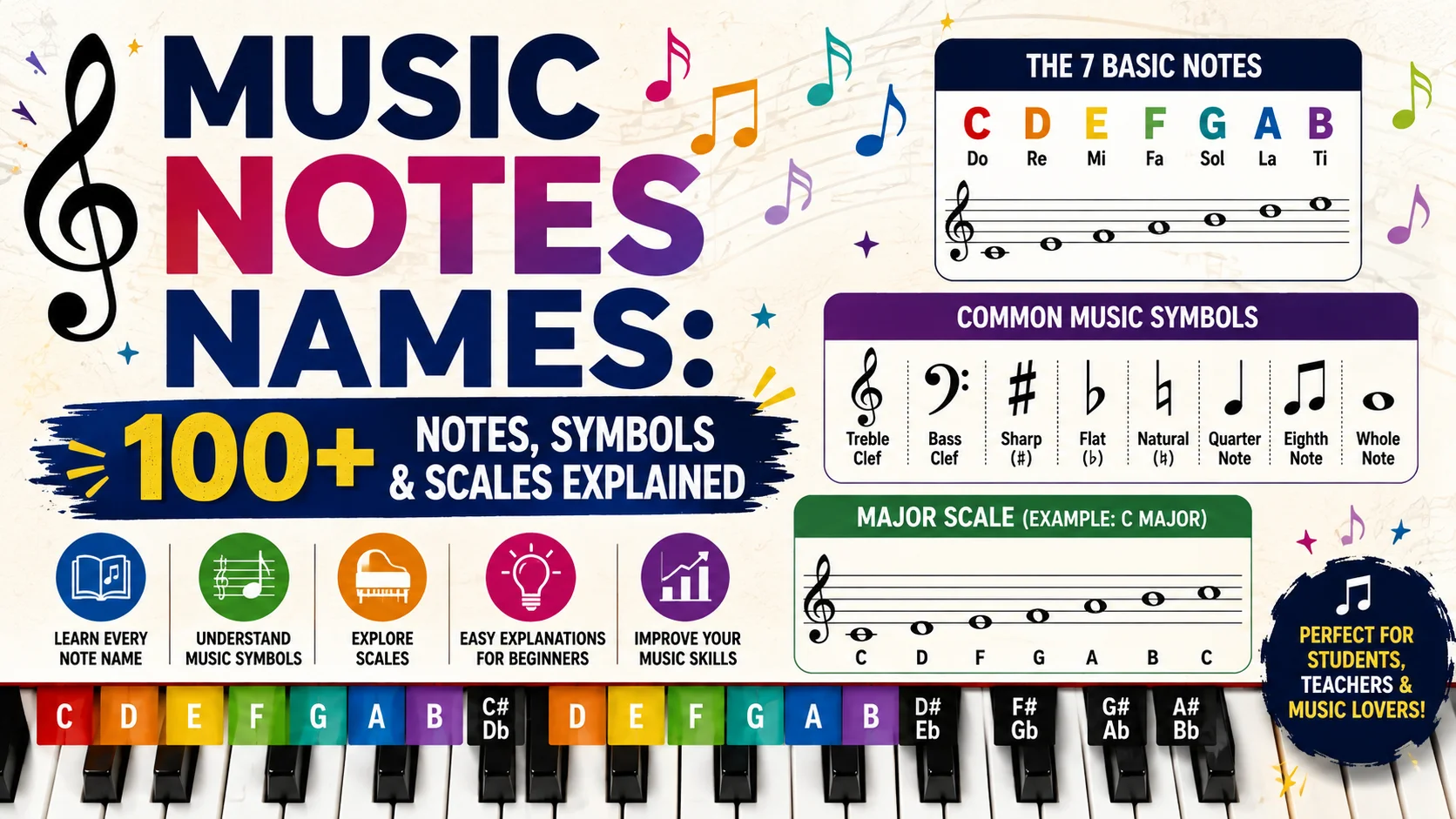
In Western music, the seven basic note names are A, B, C, D, E, F, and G. After G, the sequence begins again at A in a higher octave. You will also encounter sharps and flats, which create additional pitches between many of the natural notes. On sheet music, these notes appear on a staff and their position tells a musician which pitch to play or sing.
This guide explains the most important music notes names, including natural notes, sharp and flat notes, solfège names, notes on the treble and bass clefs, chromatic notes, scale notes, enharmonic equivalents, and octave names.
🎯 Quick Answer: What Are the Music Notes Names?
The seven basic music notes names are A, B, C, D, E, F, and G. They are called natural notes. Between some of these notes are sharp and flat notes, creating the 12 pitches commonly used in Western music. Using letter names, the chromatic sequence is C, C♯/D♭, D, D♯/E♭, E, F, F♯/G♭, G, G♯/A♭, A, A♯/B♭, and B.
🎼 The 7 Basic Music Notes Names
The easiest way to begin learning music notation is with the seven natural notes. These letters repeat over and over as pitches move higher or lower.
- A
- B
- C
- D
- E
- F
- G
These seven note names form the foundation of many scales and melodies. Once you reach G, the pattern starts again with A. For example, moving upward gives you A–B–C–D–E–F–G–A.
The same seven letters are used regardless of whether you’re reading piano music, guitar tabs converted to notation, vocal music, or orchestral sheet music.
The pitch itself can change depending on the octave. For example, middle C and a higher C have the same letter name but different pitches.
🎹 Natural Music Notes Names
Natural notes are the basic letter names without a sharp or flat accidental attached to them. They are often the first notes beginners memorize.
- A
- B
- C
- D
- E
- F
- G
- C
- D
- E
- F
- G
- A
- B
- C
- D
- E
- F
- G
- A
Although the names repeat, their pitch changes when they appear in different octaves.
On a standard piano, the white keys correspond to natural notes. The pattern of white keys repeats as you move up and down the keyboard. This repeating structure makes it easier to identify notes once you understand where C, D, E, F, G, A, and B are located.
♯ Sharp Music Notes Names
A sharp raises a note by one semitone, also called a half step. Sharp notes are written using the ♯ symbol.
Common sharp note names include:
- C♯
- D♯
- F♯
- G♯
- A♯
- C♯
- D♯
- F♯
- G♯
- A♯
- C♯
- D♯
- F♯
- G♯
- A♯
- C♯
- D♯
- F♯
- G♯
- A♯
There is normally no black key between E and F or between B and C on a standard piano. That’s why E♯ is enharmonically equivalent to F, while B♯ is enharmonically equivalent to C.
However, E♯ and B♯ can still appear in written music because note spelling depends on the musical key and theoretical context.
♭ Flat Music Notes Names
A flat lowers a note by one semitone. The symbol for a flat is ♭.
Common flat note names include:
- D♭
- E♭
- G♭
- A♭
- B♭
- D♭
- E♭
- G♭
- A♭
- B♭
- D♭
- E♭
- G♭
- A♭
- B♭
- D♭
- E♭
- G♭
- A♭
- B♭
Sharp and flat names can describe the same sounding pitch in equal-tempered music. For example, C♯ and D♭ generally sound the same on a standard piano, although their written names serve different musical purposes.
🎵 The 12 Chromatic Music Notes Names
The chromatic scale contains 12 pitch classes within an octave. If you start on C and move upward by semitones, you get the following sequence.
- C
- C♯
- D
- D♯
- E
- F
- F♯
- G
- G♯
- A
- A♯
- B
- C
- D♭
- D
- E♭
- E
- F
- G♭
- G
- A♭
- A
- B♭
- B
- C
The first group uses mostly sharp spellings, while the second uses flat spellings. Both describe the 12 pitch classes, but musicians choose one spelling according to the key and harmonic context.
For example, a piece in E major commonly uses F♯, C♯, and G♯, while music in B♭ major commonly uses B♭ and E♭.
🎶 Music Notes Names in Solfège
Solfège provides another system for naming musical notes. Instead of letters, singers and music students may use syllables.
The traditional movable-do sequence is:
- Do
- Re
- Mi
- Fa
- Sol
- La
- Ti
- Do
- Re
- Mi
- Fa
- Sol
- La
- Ti
- Do
- Re
- Mi
- Fa
- Sol
In the C major scale, these syllables correspond to:
C = Do, D = Re, E = Mi, F = Fa, G = Sol, A = La, B = Ti.
Solfège is especially useful for ear training because it helps students connect a note’s position within a scale to its sound and function.
🎹 Piano Music Notes Names
The piano is one of the easiest instruments for visualizing music notes names because the keyboard provides a clear repeating pattern.
The white keys use the seven natural notes:
- A
- B
- C
- D
- E
- F
- G
- A
- B
- C
- D
- E
- F
- G
- A
- B
- C
- D
- E
The black keys represent pitches that are commonly named with sharps or flats:
- A♯ / B♭
- C♯ / D♭
- D♯ / E♭
- F♯ / G♭
- G♯ / A♭
- A♯ / B♭
- C♯ / D♭
- D♯ / E♭
- F♯ / G♭
- G♯ / A♭
A useful beginner trick is to find every group of two black keys. The white key immediately to their left is C.
🎼 Treble Clef Music Notes Names
The treble clef is widely used for higher-pitched instruments and voices. Piano music often uses the treble clef for the right hand.
The notes on the five lines of the treble staff, from bottom to top, are:
- E
- G
- B
- D
- F
A common mnemonic is Every Good Boy Does Fine.
The notes in the four spaces are:
- F
- A
- C
- E
These spell FACE, making them particularly easy to remember.
Together, the treble clef provides a visual system for identifying pitches based on where each note sits on the staff.
🎵 Bass Clef Music Notes Names
The bass clef is used for lower-pitched notes and is common in piano left-hand music, bass instruments, cello, trombone, and other lower registers.
The five lines of the bass staff, from bottom to top, are:
- G
- B
- D
- F
- A
The four spaces are:
- A
- C
- E
- G
A common mnemonic for the spaces is All Cows Eat Grass.
Understanding both clefs is important for piano players because piano sheet music commonly combines treble and bass clefs into a grand staff.
🎹 Middle C and Its Importance
Middle C is one of the most useful reference points when learning music notation. On a standard piano, it is located near the center of the keyboard.
Its letter name is simply C, but its octave designation depends on the naming system being used. In scientific pitch notation, middle C is commonly called C4.
Middle C sits between the treble and bass staffs when piano notation is written on the grand staff. This makes it a useful landmark for beginners.
Once you can quickly identify middle C, you can begin counting upward or downward to identify surrounding notes.
🔢 Music Notes Names by Octave
An octave represents the distance between one note and another note with the same letter name at twice or half its frequency. For example, C4 and C5 are both C notes, but C5 is one octave higher.
Scientific pitch notation commonly uses numbers to identify octaves.
Examples include:
- C2
- D2
- E2
- F2
- G2
- A2
- B2
- C3
- D3
- E3
- F3
- G3
- A3
- B3
- C4
- D4
- E4
- F4
- G4
- A4
- B4
- C5
- D5
- E5
- F5
- G5
- A5
- B5
- C6
- D6
- E6
- F6
- G6
- A6
- B6
- C7
This system is especially useful when discussing instruments, digital audio, MIDI, piano ranges, and music-production software.
🌟 Music Notes Names in the C Major Scale
The C major scale is often the first scale beginners learn because it contains no sharps or flats.
Its notes are:
- C
- D
- E
- F
- G
- A
- B
- C
In solfège, these are:
- Do
- Re
- Mi
- Fa
- Sol
- La
- Ti
- Do
The intervals between these notes follow the major-scale pattern of whole steps and half steps. The half steps occur between E–F and B–C.
Because the C major scale uses only natural notes, it provides a simple introduction to scales, melodies, chords, and key signatures.
🎼 Music Notes Names in Major Scales
Every major scale contains seven different letter names before the first note repeats at the octave. The actual pitches depend on the key.
Examples include:
G major
- G
- A
- B
- C
- D
- E
- F♯
- G
D major
- D
- E
- F♯
- G
- A
- B
- C♯
- D
F major
- F
- G
- A
- B♭
- C
- D
- E
- F
B♭ major
- B♭
- C
- D
- E♭
- F
- G
- A
- B♭
The key signature tells musicians which notes should consistently be treated as sharp or flat throughout a passage unless another accidental changes them.
🎸 Music Notes Names for Guitar
Guitar players also use the same basic note names: A through G, along with sharps and flats. What changes is how those notes are positioned on the instrument.
The standard tuning of a six-string guitar, from the lowest-pitched string to the highest-pitched string, is:
- E
- A
- D
- G
- B
- E
Each fret generally moves the pitch upward by one semitone. This means guitarists can find notes by combining their knowledge of open-string names with the chromatic sequence.
For example, the sixth string begins at E. Moving one fret higher produces F, then F♯/G♭, then G, and so on.
Understanding note names helps guitarists build scales, chords, melodies, and solos rather than relying entirely on memorized finger patterns.
🎻 Music Notes Names for Violin
The four open strings of a standard violin are:
- G
- D
- A
- E
From the lowest-pitched string to the highest, the sequence is G–D–A–E.
Unlike a piano, violinists do not have fixed keys showing where each pitch lies. Players use finger placement to produce notes, making knowledge of pitch and note names particularly important.
Violin sheet music is primarily written in the treble clef. Learning the notes on that clef allows players to translate written notation into finger positions and bowing movements.
🎤 Music Notes Names for Singing
Singers use the same note names as instrumentalists. A melody might be written as:
C – D – E – G – E – D – C
A singer can learn the melody through letter names, solfège, scale degrees, or simply by listening.
Solfège can be particularly helpful for vocal training because singers learn how each pitch relates to the tonic of the key. Ear training also helps singers recognize whether a melody moves upward, downward, or repeats the same pitch.
Knowing music notes names doesn’t automatically guarantee accurate pitch, but it gives singers a useful language for discussing melodies and vocal exercises.
🔄 Enharmonic Music Notes Names
Enharmonic notes are different written names that represent the same pitch in many common tuning contexts.
Some familiar examples are:
- C♯ — D♭
- D♯ — E♭
- F♯ — G♭
- G♯ — A♭
- A♯ — B♭
- E♯ — F
- B♯ — C
- C𝄪 — D
- D𝄪 — E
- F𝄪 — G
- G𝄪 — A
- A𝄪 — B
The first six examples are especially common. The double-sharp examples are less common for beginners but become relevant in more advanced music theory.
The spelling matters because it communicates the harmonic function of a note. Two notes may sound identical while having different theoretical roles within a scale or chord.
🧠 Easy Ways to Remember Music Notes Names
Memorizing notes becomes much easier when you use several methods rather than trying to learn everything at once.
Start with the seven natural notes:
A, B, C, D, E, F, G.
Then learn the treble-clef lines and spaces separately. For bass clef, use the same approach. If you play piano, connect every written note to a physical key. If you play guitar, connect note names to strings and frets.
Flashcards, note-reading apps, and short daily practice sessions can also help. Try identifying five notes at a time rather than attempting to memorize an entire staff in one sitting.
Another effective method is to say the notes aloud while playing them. This connects visual recognition, sound, and physical movement.
❓ Frequently Asked Questions About Music Notes Names
What are the 7 music notes names?
The seven basic music notes are A, B, C, D, E, F, and G. These natural notes repeat in higher and lower octaves.
What are the 12 musical notes?
Using common sharp spellings, the 12 chromatic pitch classes are C, C♯, D, D♯, E, F, F♯, G, G♯, A, A♯, and B. Some of these pitches can also be written using flat names.
What are the names of notes in solfège?
The traditional solfège syllables are Do, Re, Mi, Fa, Sol, La, and Ti, followed by Do at the octave.
What are the notes on the treble clef?
The five treble-clef lines are E, G, B, D, F, while the spaces are F, A, C, E.
What are the notes on the bass clef?
The five bass-clef lines are G, B, D, F, A, while the spaces are A, C, E, G.
What is middle C called?
In scientific pitch notation, middle C is commonly called C4. It is an important reference point between the treble and bass ranges on piano notation.
What is the difference between a sharp and a flat?
A sharp raises a pitch by one semitone, while a flat lowers a pitch by one semitone. For example, C♯ and D♭ generally represent the same sounding pitch in equal temperament but have different spellings.
How many notes are in an octave?
In the chromatic system commonly used in Western music, there are 12 semitones in an octave. A diatonic major or minor scale typically uses seven distinct note names before reaching the octave.
Conclusion
Learning music notes names gives you the vocabulary needed to understand written music. The seven natural notes—A, B, C, D, E, F, and G—are the foundation, while sharps and flats expand the system to the 12 chromatic pitches used throughout much of Western music.
From piano keys and guitar strings to violin notation and vocal melodies, the same note names appear across different instruments. Once you understand natural notes, accidentals, octaves, clefs, scales, and solfège, reading music becomes much less intimidating.
The best way to learn is to practice a little every day. Start with the seven natural notes, memorize the treble and bass clefs, identify notes on your instrument, and gradually add sharps, flats, scales, and octave designations. With consistent practice, those unfamiliar symbols on a music staff will soon become recognizable notes that you can hear, play, and understand.

Victoria Blake is a passionate writer and naming enthusiast who enjoys exploring name meanings, origins, and trends. Through Namezpedia, she helps readers discover unique and meaningful names from around the world.