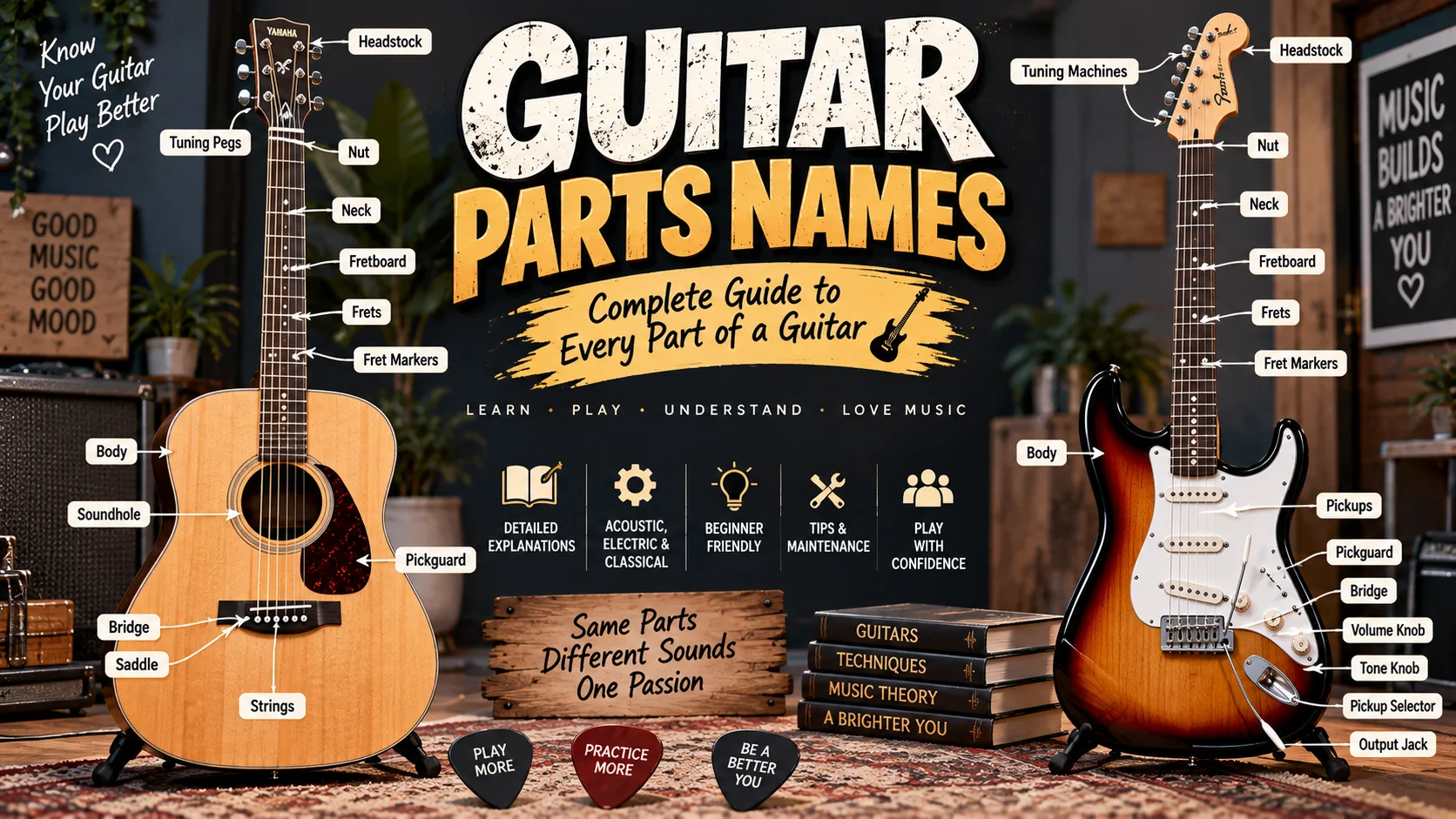
Learning the guitar parts names makes everything about playing guitar easier. When a teacher talks about the bridge, fretboard, nut, pickups, or tuning machines, you can quickly understand what they mean. You can also choose accessories, discuss repairs, and follow guitar tutorials with much more confidence.
A guitar contains many individual components, and each one has a specific job. Some parts support the strings, some help you change notes, and others shape or amplify the sound. Acoustic, electric, and classical guitars share many basic parts, but each type also has its own unique components.
If you are a beginner, you do not need to memorize every technical term at once. Start with the major sections of the instrument and gradually learn the smaller pieces. This guide explains the parts of a guitar, what they do, and how they work together.
🎸 Main Guitar Parts Names
A guitar has three major areas: the headstock, neck, and body. These sections contain almost every component you need to know.
The headstock holds the tuning machines. The neck supports the fretboard and frets, while the body houses the bridge and other components. Electric guitars also place pickups and electronic controls on the body.
Here are the most important guitar components to learn first:
- Headstock
- Tuning machines
- Tuning pegs
- Nut
- Neck
- Fretboard
- Frets
- Fret markers
- Body
- Strings
- Bridge
- Saddle
- Pickguard
- Soundhole
- Strap buttons
- Truss rod
- Heel
- Pickups
- Volume controls
- Tone controls
- Output jack
🧭 Guitar Anatomy Explained
Understanding guitar anatomy becomes much easier when you picture the instrument from top to bottom.
The headstock sits at the far end of the neck. The tuning machines attach to this section and control string tension. The nut sits between the headstock and fretboard and guides each string toward the neck.
The neck stretches from the headstock to the body. The fretboard covers the playing surface, while metal frets divide it into different note positions.
The body creates the largest part of the instrument. Acoustic guitars use the body to resonate and project sound. Electric guitars use the body to hold pickups, controls, bridges, and other hardware.
Once you understand this basic layout, the rest of the guitar parts names and functions become much easier to remember.
🎼 Headstock
The headstock forms the upper end of the guitar. It connects to the neck and holds the tuning machines.
Most headstocks also display the guitar manufacturer’s logo or design. Different guitar brands use different headstock shapes, angles, and layouts.
The headstock also helps maintain the correct path for the strings. Each string travels from the tuning machine toward the nut before continuing across the fretboard.
When you look at the guitar from the front, the headstock usually provides the easiest starting point for learning the instrument’s anatomy.
🔧 Tuning Pegs
Tuning pegs allow you to tune individual strings. You turn each peg to change the tension of its corresponding string.
When you increase string tension, the pitch rises. When you reduce tension, the pitch falls. Small adjustments can therefore bring a string into accurate pitch.
Players also call these components tuning keys or machine heads. The exact terminology varies, but the function remains the same.
If your guitar struggles to stay in tune, the tuning machines may need inspection, especially if they feel loose or rough when you turn them.
⚙️ Tuning Machines
The term tuning machines refers to the complete mechanical units attached to the headstock.
Each unit contains gears and a tuning post. The string wraps around the post, and the gear mechanism lets you make precise adjustments.
Some electric guitars use locking tuners. These systems secure the strings more firmly around the tuning post and can make string changes easier.
Good tuning machines make tuning more predictable and comfortable. They also help players make small pitch adjustments without fighting excessive movement.
🪵 Nut
The nut sits where the headstock meets the fretboard. It contains small grooves that guide the strings and keep them properly spaced.
Although the nut looks tiny, it has an important effect on guitar setup. Its height can influence string action near the first fret. Poorly shaped grooves can also create tuning problems or unwanted string noise.
Manufacturers use several materials for guitar nuts, including bone, plastic, synthetic compounds, and other engineered materials.
When you learn guitar terminology, remember the nut as the small string-guiding component between the headstock and fretboard.
🎸 Neck
The neck connects the headstock to the body. It supports the fretboard and gives your fretting hand a surface to work with.
Neck shapes vary widely. Some guitars use thin necks that feel quick and modern, while others use thicker profiles that give players a more substantial grip.
The neck also needs enough structural strength to handle the tension created by the strings. Many guitars therefore include a truss rod inside the neck.
The neck plays a major role in comfort, playability, and overall guitar design.
🎶 Fretboard
The fretboard, also known as the fingerboard, covers the front of the neck. You press the strings against this surface to create different notes and chords.
Metal frets divide the fretboard into sections. When you press a string behind a fret, you shorten its vibrating length and raise its pitch.
Guitar makers use several materials for fretboards. Common choices include maple, rosewood, ebony, and various modern synthetic materials.
The fretboard also carries fret markers that help players quickly find important positions.
📏 Frets
Frets are the thin metal strips that cross the fretboard.
Each fret provides a precise stopping point for the strings. When you press a string against the fretboard behind a fret, the fret changes the string’s effective vibrating length.
Most six-string guitars contain around 20 to 24 frets, although the exact number depends on the model.
Frets gradually experience wear because players repeatedly press and bend strings against them. A heavily played guitar may eventually need fret leveling or replacement.
🔢 Fret Markers
Fret markers help players locate positions on the fretboard quickly.
Many guitars use simple dots, while others use decorative shapes, lines, symbols, or custom inlays. Common marker positions include the 3rd, 5th, 7th, 9th, and 12th frets.
The 12th fret often receives a double marker because it marks an octave position.
Beginners can use fret markers as visual landmarks while learning scales, chords, riffs, and melodies.
🪕 Guitar Body
The body forms the largest section of the instrument. It connects with the neck and holds several important guitar components.
Acoustic guitar bodies contain a resonating chamber that helps produce and project sound. Electric guitar bodies typically carry pickups, bridges, control knobs, switches, and output jacks.
Body shape also affects comfort. Different designs change how the guitar sits against your body when you play while standing or sitting.
Manufacturers use many body shapes, including dreadnought, concert, jumbo, Strat-style, Tele-style, single-cut, double-cut, hollow-body, and semi-hollow designs.
🎵 Guitar Strings
The strings create the initial vibration that produces the guitar’s sound.
A standard six-string guitar normally uses these notes in standard tuning:
- Low E
- A
- D
- G
- B
- High E
Players can choose different string gauges depending on their style and instrument. Lighter strings usually feel easier to bend, while heavier strings can provide a different playing response.
Acoustic guitars can use steel or nylon strings depending on the design. Electric guitars typically use steel-based strings that work with magnetic pickups.
🌉 Bridge
The bridge sits on the guitar body and anchors the strings at the lower end.
On an acoustic guitar, the bridge transfers string vibration into the soundboard. That movement helps the body produce the instrument’s acoustic voice.
Electric guitars use many different bridge designs. Some provide fixed support, while others include adjustable saddles or tremolo systems.
The bridge also influences string spacing, action, intonation, and overall playing feel.
🦴 Saddle
The saddle sits within or on the bridge and provides a contact point for the strings.
Acoustic guitar saddles often use bone, synthetic materials, or other hard materials. The saddle’s height influences string action, while its shape and position help maintain proper intonation.
Many electric guitars use individual saddles for each string. Players or technicians can adjust these saddles to fine-tune string height and intonation.
Although the saddle looks small, it plays a major role in guitar setup.
🎤 Soundhole
The soundhole appears on the front of most traditional acoustic guitars.
When you pluck a string, the bridge transfers energy into the soundboard. The guitar body then uses its internal air cavity and vibrating surfaces to reinforce the sound. The soundhole allows the instrument to interact with the surrounding air.
Many acoustic guitars use a round soundhole, but modern designs sometimes place openings in different locations or use alternative shapes.
The decorative pattern around the opening is called the rosette.
🛡️ Pickguard
The pickguard protects the guitar’s finish from scratches caused by picks or fingernails.
Many steel-string acoustic guitars use pickguards below the soundhole. Electric guitars often place them around the pickups and controls.
Pickguards come in many shapes and materials. Besides protecting the finish, they can give the guitar a distinctive visual style.
Some guitars have no pickguard at all, especially when the manufacturer chooses a minimalist design.
🔩 Strap Buttons
Strap buttons provide attachment points for a guitar strap.
Most guitars have one button near the lower end of the body and another near the upper body or heel. Players can then connect a strap and comfortably play while standing.
Some guitarists install strap locks for extra security. These systems help prevent accidental strap release during movement.
🪛 Truss Rod
The truss rod runs inside the neck of many acoustic and electric guitars.
It helps the neck resist and manage the effects of string tension. A technician can adjust the rod to change the neck’s relief during a guitar setup.
Neck relief refers to the slight curvature that allows the strings to vibrate without excessive buzzing.
Truss rod adjustments require care. If your guitar has serious neck problems, a qualified guitar technician can inspect the instrument instead of risking damage through an incorrect adjustment.
🔨 Heel
The heel connects the neck and body.
It provides structural support around this important joint. Guitar makers use different neck construction methods, and the heel design changes accordingly.
Bolt-on guitars attach the neck with screws or bolts. Set-neck guitars use adhesive to secure the neck, while neck-through designs extend the central neck structure through much of the body.
⚡ Electric Guitar Pickups
A pickup detects the vibration of electric guitar strings and converts that movement into an electrical signal.
Single-coil and humbucker pickups represent two common pickup categories. Each design creates its own tonal response and interacts differently with the guitar’s electronics.
The pickup position also affects the sound. Bridge pickups often create a brighter response, while neck pickups can produce a fuller and warmer character.
Some guitars use two pickups, while others use three or even more.
🎚️ Pickup Selector Switch
The pickup selector switch lets you choose which pickup sends its signal through the guitar’s electronics.
A two-pickup guitar may offer bridge, neck, and combined positions. Three-pickup guitars often provide several additional combinations.
Players use the selector to change tone quickly during songs. This simple switch can therefore become an important part of a guitarist’s performance setup.
🔊 Volume Knob
The volume knob controls the strength of the guitar’s electrical output.
Turning the knob down reduces the signal sent toward the amplifier. Turning it up increases the output.
Many guitarists use the volume control creatively. They can lower the volume for a softer sound and raise it when they need more presence.
Some electric guitars use one master volume knob, while others provide separate controls for individual pickups.
🎛️ Tone Knob
The tone knob changes the frequency balance of an electric guitar’s signal.
Depending on the circuit, reducing the tone setting can remove some high-frequency content and create a warmer sound. Increasing the tone setting generally preserves more treble.
Different guitars use different tone circuits. Some models include one tone control, while others provide separate controls for multiple pickups.
🔌 Output Jack
The output jack connects an electric guitar to an amplifier, effects pedal, audio interface, or other equipment.
The guitar sends the pickup signal through this connection. Acoustic-electric guitars also use output jacks when players want to amplify the instrument.
A loose jack can create crackling, cutting out, or unwanted noise. A technician can usually repair or replace a damaged jack without changing the guitar’s main structure.
🎚️ Guitar Electronics
Electric guitars contain several electronic components that work together.
The pickups detect string movement. Wires carry the signal to the selector switch and control pots, while the output jack sends the final signal toward external equipment.
Some guitars also include active electronics, preamps, coil-splitting switches, phase controls, boost circuits, or onboard equalization.
Understanding this basic signal path helps beginners understand how an electric guitar interacts with pedals and amplifiers.
🧲 Pickup Pole Pieces
Some pickups contain visible pole pieces positioned underneath individual strings.
These magnetic components help the pickup detect string movement. Depending on the pickup design, players may see adjustable screws or fixed pole pieces.
Pickup height also matters. A technician can adjust the distance between the pickup and strings to balance output and response.
🎸 Pickup Rings
Pickup rings surround certain electric guitar pickups and help secure them to the body.
You can often find pickup rings around humbuckers on many electric guitar designs. Other guitars mount pickups directly into the body or pickguard.
The rings come in different shapes and heights to match particular pickup configurations.
🔄 Tremolo Bridge
Some electric guitars use a tremolo bridge that lets players change string tension with a movable arm.
Moving the bridge mechanism can raise or lower the pitch temporarily. Guitarists use this effect for subtle pitch movement or dramatic dive effects.
Different manufacturers use different tremolo designs. Some systems offer simple movement, while locking systems provide greater stability during aggressive playing.
🎵 Whammy Bar
A whammy bar attaches to certain tremolo systems.
The player moves the arm to change string tension and create pitch effects. Depending on the bridge design, the player may raise or lower the pitch.
Not every electric guitar includes a whammy bar. Many guitars use fixed bridges instead.
🧰 Bridge Pins
Many steel-string acoustic guitars use bridge pins to secure the strings.
The ball end of each string sits inside the bridge, while the bridge pin holds the string in position. Players remove these pins when they change acoustic guitar strings.
Bridge pins come in different materials and decorative styles. Some players replace them as part of a cosmetic upgrade.
🏗️ Acoustic Guitar Bracing
Acoustic guitars contain internal braces that reinforce the body.
These braces help the guitar withstand string tension while allowing the soundboard to vibrate effectively. Guitar makers carefully design their placement because bracing affects both structural strength and acoustic response.
X-bracing appears on many steel-string acoustic guitars. Classical guitars often use different patterns, such as fan bracing.
You cannot see most bracing during normal use because the pieces sit inside the guitar body.
🪵 Soundboard
The soundboard, or guitar top, forms the main front surface of an acoustic guitar.
When you pluck the strings, the bridge transfers their energy into the soundboard. The top then vibrates and works with the body cavity to produce the guitar’s acoustic voice.
Spruce and cedar commonly appear in acoustic guitar construction, although manufacturers use many other woods and materials.
The soundboard represents one of the most important parts of an acoustic instrument.
🧱 Guitar Back and Sides
The back and sides create the walls of an acoustic guitar’s body.
Together with the top, they form the internal air cavity that supports acoustic resonance. Different woods and construction techniques can influence the guitar’s tonal response.
Manufacturers use materials such as mahogany, rosewood, maple, and various modern alternatives for acoustic guitar bodies.
The shape and thickness of these sections also contribute to the instrument’s projection and feel.
🎨 Rosette
The rosette surrounds the soundhole on many acoustic guitars.
Guitar makers use wood, shell, plastic, and other materials to create rosette designs. Simple instruments may feature a plain circular pattern, while handcrafted guitars can display intricate mosaics.
The rosette primarily adds decoration, but it also forms part of the design around the soundhole.
✨ Binding
Binding runs along the edges of some guitar bodies, necks, and headstocks.
It protects vulnerable edges and gives the instrument a finished appearance. Manufacturers can use plastic, wood, or other materials for binding.
High-end guitars may use contrasting colors or decorative patterns to highlight the instrument’s shape.
🧵 Purfling
Purfling refers to decorative lines or inlay patterns that guitar makers place around certain parts of an instrument.
You may see purfling around the top of an acoustic guitar, especially on traditional or handcrafted instruments.
The design can range from simple lines to complex geometric patterns.
🎻 F-Holes
Some hollow-body and semi-hollow electric guitars use f-holes instead of a traditional round soundhole.
The openings resemble the letter “f,” which explains the name. This design comes from the visual language of older stringed instruments.
F-holes can contribute to the guitar’s acoustic characteristics and give hollow-body instruments a distinctive appearance.
🎼 Acoustic Guitar Parts Names
Acoustic guitars rely heavily on their physical construction to create sound. Important acoustic guitar components include the body, soundboard, soundhole, bridge, saddle, bridge pins, bracing, neck, fretboard, nut, headstock, tuning machines, and strings.
When you strum an acoustic guitar, the strings vibrate and transfer energy through the bridge. The soundboard responds to that energy, while the body cavity helps reinforce the sound.
Acoustic-electric guitars add pickups or preamp systems so players can connect the instrument to an amplifier or audio system.
⚡ Electric Guitar Parts Names
Electric guitars share several structural parts with acoustic guitars, but they add an electronic signal system.
Important electric guitar parts include pickups, pickup selector switches, volume knobs, tone controls, output jacks, bridges, saddles, and sometimes tremolo systems.
The solid body does not need to project sound in exactly the same way as an acoustic guitar. This freedom allows manufacturers to create many different body shapes and hardware layouts.
🎻 Classical Guitar Parts Names
Classical guitars have their own construction traditions.
They usually use nylon strings and feature wider necks than many steel-string acoustic guitars. Classical guitar bridges typically use a different string attachment method from steel-string acoustic guitars.
Important classical guitar components still include the headstock, tuning machines, nut, neck, fretboard, frets, body, bridge, saddle, soundboard, back, sides, and internal bracing.
🔍 Guitar Hardware Parts
The term guitar hardware usually covers many of the physical metal or mechanical components attached to the instrument.
Common hardware includes tuning machines, bridges, saddles, strap buttons, screws, pickup rings, control plates, switches, and output jacks.
Electric guitar hardware can strongly influence appearance and maintenance. Acoustic guitar hardware tends to focus more heavily on string support, bridge construction, and tuning.
🆚 Acoustic vs. Electric Guitar Parts
Acoustic and electric guitars share a basic structure, but their sound-producing systems differ.
| Guitar Part | Acoustic Guitar | Electric Guitar |
|---|---|---|
| Headstock | Yes | Yes |
| Neck | Yes | Yes |
| Fretboard | Yes | Yes |
| Frets | Yes | Yes |
| Strings | Yes | Yes |
| Nut | Yes | Yes |
| Bridge | Yes | Yes |
| Saddle | Yes | Often |
| Soundhole | Usually | Usually no |
| Pickups | Optional on acoustic-electric | Yes |
| Volume controls | On amplified models | Usually |
| Tone controls | On some models | Usually |
| Output jack | Acoustic-electric models | Yes |
| Pickguard | Common | Common on many models |
| Tremolo | Rare | Available on some models |
| Internal acoustic bracing | Yes | Usually no equivalent system |
🧠 How Guitar Parts Work Together
Every guitar component contributes to the instrument’s overall performance.
The strings create vibration when you pick or strum them. The nut and bridge establish the string’s position, while the frets let you shorten the vibrating length and create different notes.
On an acoustic guitar, the bridge transfers string energy into the soundboard. The body then resonates and projects the sound.
On an electric guitar, the pickups detect the vibrating strings and create an electrical signal. The controls shape that signal before the output jack sends it to an amplifier.
This interaction explains why guitar setup involves more than simply changing strings. The nut, bridge, saddle, neck relief, fret condition, pickups, and electronics can all affect the playing experience.
🛠️ Which Guitar Parts Need Regular Maintenance?
Some guitar components require more attention than others.
Strings naturally wear out and need replacement. Frets can develop grooves after extensive playing. Tuning machines may loosen, and output jacks or switches can develop noise.
Acoustic guitars also need appropriate humidity and storage conditions, especially when they use natural wood. Extreme changes in humidity can affect the body and neck.
Regular cleaning, careful string changes, proper storage, and occasional professional setup can help keep your instrument comfortable and reliable.
🎯 Why Should Beginners Learn Guitar Parts Names?
Knowing the names of guitar parts improves communication.
If an instructor tells you to move your finger to the fifth fret, you will immediately understand the location. If a repair technician talks about neck relief, the nut, or the saddle, you will know which area they mean.
Guitar terminology also makes online learning easier. Tutorials often assume that viewers already understand basic anatomy, so learning these terms early can save time.
You will also find it easier to shop for replacement parts, accessories, strings, and maintenance tools.
🎨 How to Remember Guitar Parts Easily
You don’t need to memorize every component in one sitting. Start at the top and move downward.
Remember the sequence:
Headstock → Tuning Machines → Nut → Neck → Fretboard → Frets → Body → Bridge → Saddle
Then add the specialized parts:
Pickups → Controls → Output Jack → Pickguard → Soundhole → Strap Buttons
Spend a few minutes pointing at each component on your own guitar. Physical practice makes the terminology much easier to remember.
🎸 Guitar Parts Every Beginner Should Know First
If you just started learning guitar, focus on these ten components:
- Headstock
- Tuning machines
- Nut
- Neck
- Fretboard
- Frets
- Strings
- Body
- Bridge
- Saddle
Once you know these, add pickups and electronic controls if you play an electric guitar.
You can learn advanced components such as the truss rod, bracing, tremolo system, pickup pole pieces, and internal electronics later.
❓ FAQs About Guitar Parts Names
What are the main parts of a guitar?
The main parts include the headstock, tuning machines, nut, neck, fretboard, frets, strings, body, bridge, and saddle. Electric guitars also commonly include pickups, controls, switches, and an output jack.
What is the long part of a guitar called?
The long section between the headstock and body is the neck. The fretboard covers its front playing surface.
What are the metal lines on a guitar called?
The metal strips across the fretboard are called frets. They divide the neck into different note positions.
What is the top of an acoustic guitar called?
The top is also called the soundboard. It vibrates when the bridge transfers energy from the strings.
What holds guitar strings in place?
The bridge and saddle support the strings at the body end, while the tuning machines hold them at the headstock end. Acoustic guitars may also use bridge pins.
What are guitar tuning keys called?
People commonly call them tuning pegs, tuning keys, machine heads, or tuning machines.
What is the small piece between the headstock and fretboard?
That component is the nut. It guides and spaces the strings as they move from the headstock onto the fretboard.
What is a guitar pickup?
A pickup detects string vibration on an electric guitar and converts that vibration into an electrical signal.
What is the hole in an acoustic guitar called?
The large opening on a traditional acoustic guitar is called the soundhole.
What does the bridge do on a guitar?
The bridge anchors the strings and transfers their energy into the body. Its design also affects string spacing, action, and intonation.
What is the difference between a bridge and a saddle?
The bridge forms the larger structure that anchors the strings. The saddle sits within or on the bridge and provides a contact point for the strings.
What does a truss rod do?
A truss rod helps the neck manage string tension and allows technicians to adjust neck relief.
How many strings does a standard guitar have?
A standard guitar usually has six strings. Some instruments use seven, eight, twelve, or other string configurations.
What are the parts of an electric guitar?
Common electric guitar parts include the headstock, tuning machines, nut, neck, fretboard, frets, body, strings, bridge, pickups, pickup selector, volume controls, tone controls, and output jack.
What are the parts of an acoustic guitar?
Important acoustic guitar parts include the headstock, tuning machines, nut, neck, fretboard, frets, body, soundboard, soundhole, bridge, saddle, bridge pins, strings, and internal bracing.
What is the fretboard?
The fretboard is the playing surface on the front of the neck. Players press the strings against it to form notes and chords.
What is a pickguard?
A pickguard protects the guitar’s finish from scratches caused by picks and fingernails.
What is the heel of a guitar?
The heel marks the area where the neck connects with the guitar body.
🎯 Final Thoughts
Learning the guitar parts names gives every guitarist a stronger foundation. Once you recognize the headstock, tuning machines, nut, neck, fretboard, frets, strings, body, bridge, and saddle, guitar terminology becomes much easier.
Acoustic guitars depend heavily on the soundboard, body, bridge, saddle, and internal bracing to create natural sound. Electric guitars add pickups, switches, controls, and an output jack to turn string vibrations into an amplified signal. Classical guitars use their own traditional construction and nylon-string setup.
You don’t need to master every technical term immediately. Start with the major components, identify them on your own instrument, and learn the smaller parts as you gain experience.
The more you play, tune, clean, restring, and maintain your guitar, the more familiar these names will become. Before long, terms such as fretboard, saddle, bridge, pickup, nut, and truss rod will feel like everyday guitar vocabulary.

Victoria Blake is a passionate writer and naming enthusiast who enjoys exploring name meanings, origins, and trends. Through Namezpedia, she helps readers discover unique and meaningful names from around the world.